
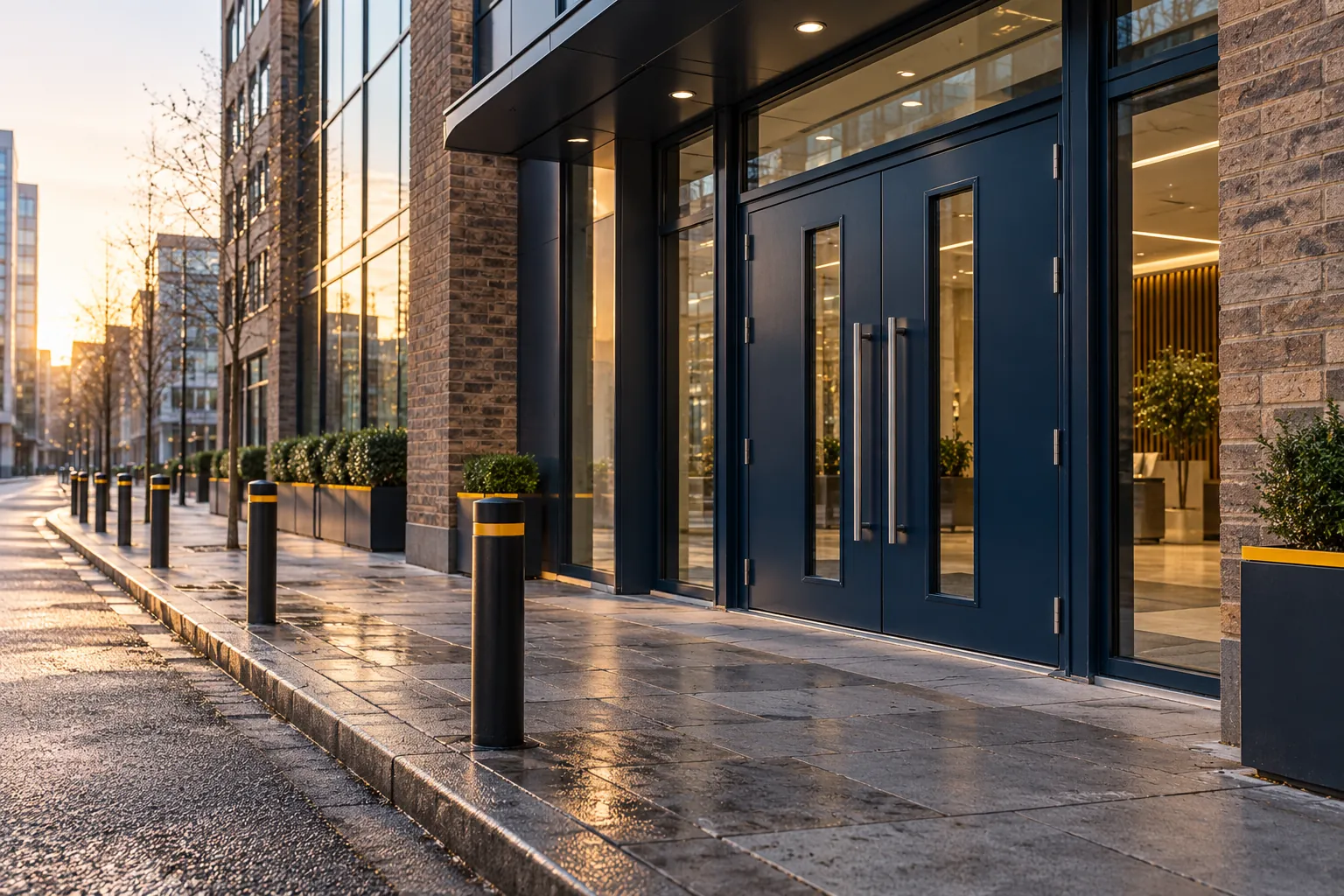
Fire · EI 30 to EI 120
Thermally Broken Doors in London
Thermally broken doors for London offices, hospitals, schools and hotels, with low U-values, LPS 1175 ratings and fire options, built to surveyed sizes.
- ✓Third-party test evidence with every product
- ✓Written specification you can issue to tender
- ✓Supplied and installed in London
Get a free quote in London
Rating, written specification and budget range within one working day.
Confidential. No cost, no obligation.
Third-party tested
Evidence with every quote
UK manufactured
Made to your sizes
One accountable team
Specify, supply, install
Confidential handling
Details never shared
Supplied and installed in London
What we supply in London
A rated door on a London external wall faces two jobs at once. It must hold its fire or forced entry rating, and it must stop heat leaking out of a heated building through steel that conducts it straight outside. A thermal break sits inside the doorset to slow that leak, without giving up the rating.
The break is a low conductivity barrier built into the leaf and the frame, between the inner skin and the outer skin. It interrupts the path heat takes through the metal, so the inner face stays warm, condensation is limited, and the doorset can meet what building regulations ask for on heat loss.
Thermally broken doors suit heated London buildings where the entrance doors sit in the thermal envelope and every watt is counted by the energy assessor: schools, hospitals, offices and hotels. The break is specified beside the rating, never after it, and the physical security in London area page maps where rated protection sits across the city.
Where London buildings need thermally broken doors
Offices in the City, Canary Wharf and the West End hold entrance doors in near constant use, and heat leaves the building at each one. Hotels and theatres follow the same pattern at main entrances and stage doors, and the doors must keep the entrance working in cold weather while the rating stays in place.
Hospitals use them where wards, clinics and imaging suites open to the outside air. Guy’s, St Thomas’ and St Bartholomew’s hold corridors and plant rooms where the door needs a fire rating and the frame needs a thermal break, since a cold inner face draws condensation and a draughty entrance lets heat out through winter. Schools and universities bring the same pattern to main entrances, sports halls and student accommodation.
Retail and transport buildings bring heavy footfall to the same question. Shops and arcades in the West End and the City hold entrance screens with doors in near constant use, and stations such as London Bridge, Waterloo and Victoria hold public entrances that face the street and the weather. At such openings a thermally broken doorset keeps the doorway in use through cold weather while the rating holds.
How a thermal break sits with a security or fire rating
A plain steel doorset is a bridge for heat: the metal carries warmth from the inside face straight to the outside face. The break is a low conductivity barrier set into the frame and the leaf, and it cuts that bridge. The doorset keeps its fire or forced entry rating, since the break sits inside the tested assembly and the test evidence runs across the whole doorset with the break in place.
The thermal figure and the rating figures are checked apart from each other. A fire class runs E, EW or EI, for half an hour up to two hours, and the evidence file ranks BS EN 1634-1:2014+A1:2018 beyond the U-value sheet, with the fire class recorded on the next page. Forced entry is given in SR classes, and the checklist ranks LPS 1175 Issue 8.2 (September 2024) then the fire class, then the U-value for the exact doorset. A U-value belongs to the exact doorset on its test evidence, and the figure must not be borrowed from another doorset in the same range. The thermal and weather performance guide sets out how the two sets of figures sit side by side.
Glazing, seals and ironmongery all move the result. A vision panel needs glass that matches the rating and the thermal target together, seals must close the gaps around the frame, and the threshold must suit the floor and the exposure of the elevation. The dual certification guide shows how a doorset carrying a fire rating together with a security rating holds good, and the steel or aluminium security doors guide compares the two materials on strength, ratings and looks.
Rating guide for thermally broken doors in London
Read the table as a rough guide only. The energy assessor sets the thermal figure, the fire strategy sets the fire class, and the security consultant sets the SR class, and each figure needs its own evidence on the same doorset.
| London use | Thermal need | Rating to ask for | Doorset form |
|---|---|---|---|
| Office entrance, City or Canary Wharf | Low U-value, high footfall | LPS 1175 SR2, fire class where the strategy names one | Steel doorset, glazed screen |
| Hospital corridor or ward entrance | Warm inner face, no condensation | Fire class EI 30 to EI 60, LPS 1175 SR2 | Steel doorset, vision panel |
| School or university entrance | Heat held through the teaching day | LPS 1175 SR2 | Steel doorset, manual or powered |
| Hotel or theatre entrance | Warm lobby, heavy daily use | LPS 1175 SR2, fire class where the strategy names one | Steel doorset, glazed screen |
| Plant room or service entrance | Heat held, weather exposure | LPS 1175 SR2 | Steel doorset, solid leaf |
How to specify thermally broken doors in London
Start with the four performances, not one. Thermal, security, fire and weather each have their own evidence, and the specification should name all four for each opening: the U-value of the exact doorset, the SR class, the fire class where the strategy names one, and the weather exposure of the elevation. The keeping dual certification valid guide sets out how a doorset carrying both ratings stays valid after handover.
Then settle the break itself. Ask how the break runs through the leaf and the frame, how it is detailed at the threshold, and how the ironmongery is fixed without bridging it, because the threshold and the fixings are the weak points. Through-bolted items need insulating sleeves or pads where the design allows, and the seals must close the gaps the frame leaves.
Finish with the glazing and the finish. A glazed vision panel needs glass chosen for the rating and the thermal target, and the security doors range holds the doorset forms that the specification can draw on. The finish should suit the elevation without hiding the seals, and the fire rated steel doors range holds the forms that carry a fire class. The fire door regulations for offices guide deals with the fire side for office openings.
Project steps for thermally broken doors in London
Every job starts with a survey at the opening. The surveyor measures width, height and frame depth, checks the wall build and the threshold level, and notes the exposure of the elevation and the heating pattern of the rooms behind the door. The measurements, the exposure notes and a sketch of every opening goes into the record, and the specification is built from those, not from a catalogue size.
Then the written record names the four performances for each opening: U-value for the exact doorset, SR class, fire class and weather exposure, with the break detail and the threshold detail beside them. The fire classes are explained on the fire ratings page, while the LPS 1175 standard page holds the SR classes.
Doorsets are built to the sizes the survey recorded. Fitting is planned around teaching hours, clinic hours or trading hours where the programme allows it. [email protected] takes the sizes of each opening and the four figures each doorset needs, or use the quote form for the same details. A written specification, a check of the figures and a budget range come back inside one working day.
Mind the threshold first. The break can run clean through leaf and frame and still fail at the threshold, so ask how the threshold is broken before the doorset is ordered.
Questions about thermally broken doors in London
What U-value should a London office door have?
The energy assessor sets it, and the figure belongs to the exact doorset on its test evidence. No figure should be borrowed from another doorset in the same range, and the specification should name the U-value beside the SR class and the fire class for the same opening.
Does a thermal break weaken a security door?
No, where the two systems are engineered together. The break sits inside the tested assembly, and the security construction sits inside it: reinforced lock and hinge areas, multi-point locking and a deep frame. The evidence file takes in the whole doorset, break included.
Can one doorset carry a fire rating and an LPS 1175 rating?
Yes, where the evidence covers both on the same construction. The fire class and the SR class must be tested on the same doorset, and the dual certification guide explains the conflicts to resolve before the order goes in.
Is PAS 24 enough for a commercial thermally broken door?
No. PAS 24 is residential only, and a commercial door needs its LPS 1175 class and its fire class on their own evidence. A specification that cites PAS 24 for a London office or school entrance has the wrong standard on it.
Need a warm rated door for a London building? Send the opening sizes and the four figures each doorset needs.
Other areas
Thermally broken doors in other areas
Ready to specify your project?
Free assessment, written specification and test evidence. Reply within one working day.