
Sectors
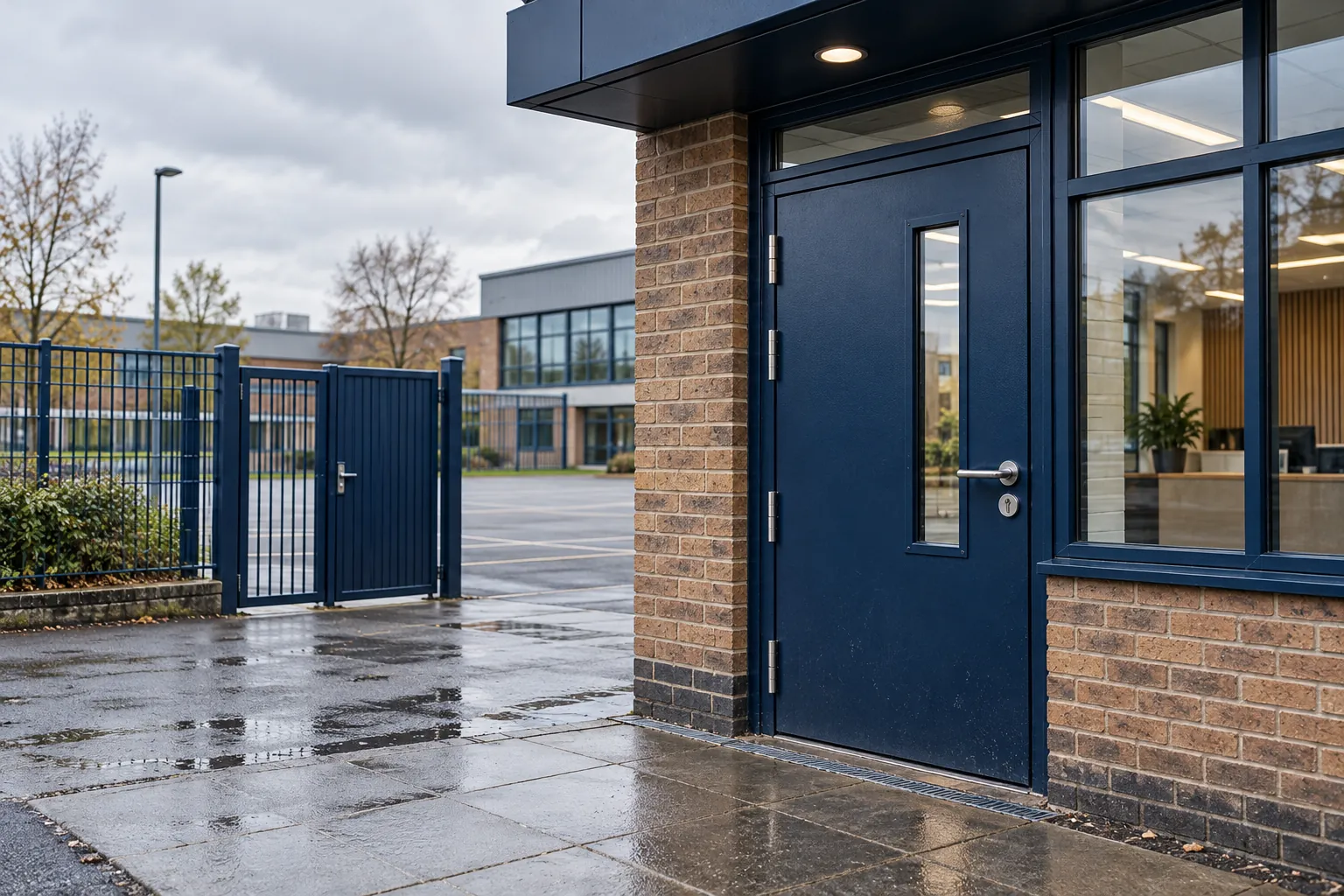
Security doors and gates for schools
Security doors for schools in the UK: rated entrances, gates and perimeter lines that protect pupils without blocking fire escape or safeguarding.
- ✓Third-party test evidence with every product
- ✓Written specification you can issue to tender
- ✓Supplied and installed across the UK
Get a free project quote
Rating, written specification and budget range within one working day.
Confidential. No cost, no obligation.
Third-party tested
Evidence with every quote
UK manufactured
Made to your sizes
One accountable team
Specify, supply, install
Confidential handling
Details never shared
A school entrance should delay an intruder, let staff see who is arriving, and still let everyone out fast in a fire. That combination comes from a rated doorset matched to the opening.
- B3, C5, D10LPS 1175 ratings: 3, 5 and 10 minutes of attack time
- E, EW, EIFire classifications to EN 1634-1, 30 to 120 minutes
- PAS 24Enhanced security for doors and windows, below LPS 1175
- One policyThe school decides lockdown policy; a door alone is not a plan
Lockdown and intruder resistance at entrances
The main entrance is the first decision on any school site, because intruders try it first and every visitor uses it. A steel security door here needs a rating that matches the threat the school has assessed, not the highest rating in the catalogue. For most schools that means LPS 1175 at B3 or C5, with frame, fixings and hardware tested as part of the same doorset.
Vision matters as much as strength: staff at reception should see who is at the door before it opens, so glazed sections and vision panels belong in the specification, with glazing rated to match. Where the entrance also serves as a fire exit, the lock must hold from the outside and release from the inside in one action. Inside, classroom doors form a second line: in a lockdown, staff need to close a classroom door, lock it from the inside, and keep it closed until the lockdown lifts. A SR2 security door on a corridor gives staff a real barrier.
Check the doorset, not the leaf. A rating belongs to the tested assembly: leaf, frame, fixings, glazing and hardware together. Ask for test evidence that names the whole doorset.
Honest limit first: no door makes a lockdown plan. The school decides the policy, the signal and how staff and pupils practise it. Doors buy time inside that plan. The LPS 1175 standards page sets out the ratings, and the LPS 1175 Issue 8 guide explains attack time and tool categories.
The safeguarding perimeter: gates, fencing lines and bollards at drop-off
A school perimeter works as one line, not as separate products. A strong gate beside a gap in the fence line is not a perimeter. Security gates should match the fence line in height and resistance, and the posts and hinges need the same attention as the leaf, because a sagging gate ends up propped open.
Drop-off areas deserve their own thinking. At drop-off, children queue while cars and deliveries arrive at the same point, so the design should separate vehicles from waiting children. Security bollards along the edge of a drop-off zone keep a vehicle out of the waiting area, but a bollard that is only a visual marker will not stop a vehicle. Where the risk assessment calls for vehicle impact resistance, the bollard needs a tested rating, foundation included. A marker bollard and a hostile vehicle mitigation bollard are different specifications. The guide to choosing HVM bollards explains the difference, and the vehicle impact ratings page sets out how a rating states vehicle mass, speed, angle and penetration. See the education sector page and all sectors.
Visitor entrances and controlled access
Visitors should have one obvious route, through reception, with no second route into teaching areas. That single route makes signing in, identification checks and escorting workable. A visitor who reaches a classroom corridor without passing reception has bypassed the whole system. Secondary entrances for staff, deliveries and kitchens need their own controlled locks, on the same access plan as the main entrance.
At the visitor entrance, the door and the intercom work together. Staff speak to and see the visitor before releasing the door. A door that can be pulled open from outside defeats the intercom, so the lock should stay engaged until released, and the door should close and latch on its own. Turnstiles and pedestrian speed gates suit older pupil and staff entrances on larger sites, but they suit a primary entrance poorly, where pushchairs, wheelchairs and small children pass through together. Settle in writing before ordering what happens to each lock when the fire alarm sounds, door by door. The guide to specifying security doors and the specification mistakes guide cover the questions to ask.
Fire escape versus security: how a rated doorset resolves the conflict
Fire escape and security pull in opposite directions, and schools feel it most. Fire safety needs a door that opens fast from the inside, with no key or code. Security needs a door that resists opening from the outside. A rated doorset resolves the conflict by testing both jobs in one assembly: attack resistance from outside, release from inside in one action.
Fire ratings are E (integrity), EW (integrity and radiation) or EI (integrity and insulation), with 30, 60, 90 or 120 minutes, tested to EN 1634-1. The rating at each opening comes from the fire risk assessment. Fire rated steel doors can carry both a fire classification and a forced entry rating in the same doorset, and the fire ratings page explains the classifications. Both ratings must name the same doorset reference.
Hardware is where dual rated doors fail in practice. A closer, lock or panic device changed after the test can void the evidence, because the test attacked the assembly as built. LPS 1175 swinging security doors and swing security doors should therefore be ordered with the hardware included in the tested specification. The dual certification guide and the guide to keeping an LPS 1175 rating valid cover the detail.
Vandal and abuse resistance on corridors and plant rooms
Corridor doors in a school take heavy abuse every term. They are kicked, wedged open and swung hard on their hinges. A steel door with protected hinges and a frame fixed into the structure handles that load, while a light door starts to drag and stops latching. Once a corridor door stops latching, its rating is academic: the door is effectively open.
Plant rooms, boiler rooms, kitchens, IT rooms and server rooms need a different kind of attention. They hold costly equipment that is dangerous to tamper with. Steel louvred doors suit plant rooms where ventilation matters, letting air move while keeping the room locked, but louvre and lock sections must both be part of the rated specification. A louvre cut into a rated leaf after the fact is a hole in a rated door. Security shutters over a canteen serving hatch or sports store counter let staff close an area fast at the end of the day; sliding security doors suit wide openings where a swinging leaf would block circulation.
PAS 24, LPS 1175 and Secured by Design
PAS 24 and LPS 1175 are different routes to a secure door. PAS 24 is enhanced security for doors and windows, tested against a lower threat level than LPS 1175. LPS 1175 tests against named tool categories over a set attack time, with the rating written as a tool category letter plus minutes. The table below sets out the levels for schools.
| Rating | Attack time | Tools in the test | School use |
|---|---|---|---|
| B3 (SR2) | 3 minutes | Screwdrivers, pliers, hand saws | Main entrances, corridors |
| C5 (SR3) | 5 minutes | Crowbars, drills, chisels | Plant rooms, IT rooms |
| D10 (SR4) | 10 minutes | Sledgehammers, disc cutters, jigsaws | Isolated site buildings |
| PAS 24 | Not an LPS 1175 rating | Lower threat level than LPS 1175 | Lower risk doors |
Choosing between them is a risk decision. A B3 door at a staffed main entrance gives a different level of protection from the same door on an unstaffed building at the edge of a site, where nobody would see an attack. The rating should follow the risk assessment for that opening. The LPS 1175 versus PAS 24 guide compares the two routes; the PAS 24 requirements guide covers what PAS 24 tests.
Secured by Design is a separate question from the rating. It is the official police security initiative, owned by UK Policing, accrediting products to its Police Preferred Specification and publishing design guidance for schools. For a new school, check early whether a planning condition or a funder requires Secured by Design, and raise it with the local police designing out crime officer at design stage. Secured by Design is not itself a door rating: it points to standards such as PAS 24 and LPS 1175. The scheme’s own site is at securedbydesign.com, and the Secured by Design guide explains when it applies. Large schools may also fall within the scope of the Terrorism (Protection of Premises) Act 2025, known as Martyn’s Law (Royal Assent, April 2025): standard tier 200 to 799 people, enhanced tier 800 or more, implementation period at least 24 months, regulator the Security Industry Authority, and no specific products mandated. The Martyn’s Law standards page and the Martyn’s Law guide cover the detail.
Out-of-hours cover, finishes and noise
Sports halls let to community groups create a second school day. The doors need to let a community group into one zone while keeping teaching areas, plant rooms and offices locked. High performance roller doors at a sports hall loading entrance, and shutters over counters and stores, let staff close off parts of the building without locking the whole site. Write the community use access plan separately from the school day plan: the people, hours and risks differ.
Finishes on school doors work harder than finishes elsewhere. A powder coated finish matches doors to the building colour scheme; the powder coating page covers the options. The finish must survive daily cleaning and knocks: a pale finish shows every mark, a darker finish hides minor damage. Noise matters too: a heavy door with a strong closer slams, disturbing teaching next door all day. Ask for the closer and seal specification alongside the rating. The installation page covers fitting, the maintenance page covers upkeep, and the design page and security consultancy page cover earlier stages.
Can a school lock classroom doors and still meet fire escape rules?
Yes, if the lock releases from the inside in one action and the door is part of a tested doorset carrying both the fire classification and the security rating. The lock must never need a key or a code from the inside.
Is Secured by Design mandatory for a new school?
Not as a general rule. A planning condition or a funder may require it for a particular project, so ask early whether it applies to that school. It accredits products and publishes design guidance; it is not a door rating.
What rating suits a plant room or IT room door?
Usually a higher rating than a classroom door, because they hold valuable or dangerous equipment and are often unstaffed. C5 is a common choice where crowbars and drills are the expected tools.
Who decides the school lockdown policy?
The school does. Doors, gates and locks support the policy, but they do not replace it. It covers the signal, who gives the instruction, and how staff and pupils practise.
Get a free quote
Related
More in sectors we protect
Products
One supplier for the whole building envelope
Ready to specify your project?
Free assessment, written specification and test evidence. Reply within one working day.