
Sectors
Security shutters and doors for shops
Security shutters for shops: choose solid, perforated or grille shutters, retractable grilles and rated doors for a UK shopfront, rear access and stockroom.
- ✓Third-party test evidence with every product
- ✓Written specification you can issue to tender
- ✓Supplied and installed across the UK
Get a free project quote
Rating, written specification and budget range within one working day.
Confidential. No cost, no obligation.
Third-party tested
Evidence with every quote
UK manufactured
Made to your sizes
One accountable team
Specify, supply, install
Confidential handling
Details never shared
For most shops, a perforated shutter or retractable grille on the front, a rated steel door at the rear, and a locked stockroom door cover the three weak points. Solid shutters hide the display and often fail planning, while an unrated rear door undoes a strong front. Judge each opening on its own risk.
- Solid, perforated or grilleThree shutter types for a shopfront
- B3 to D10LPS 1175 ratings for rated doors and shutters
- E, EW or EI 30 to 120Fire classifications to EN 1634-1
- Check firstPlanning rules for external shutters
Shopfront: shutters, grilles or doors
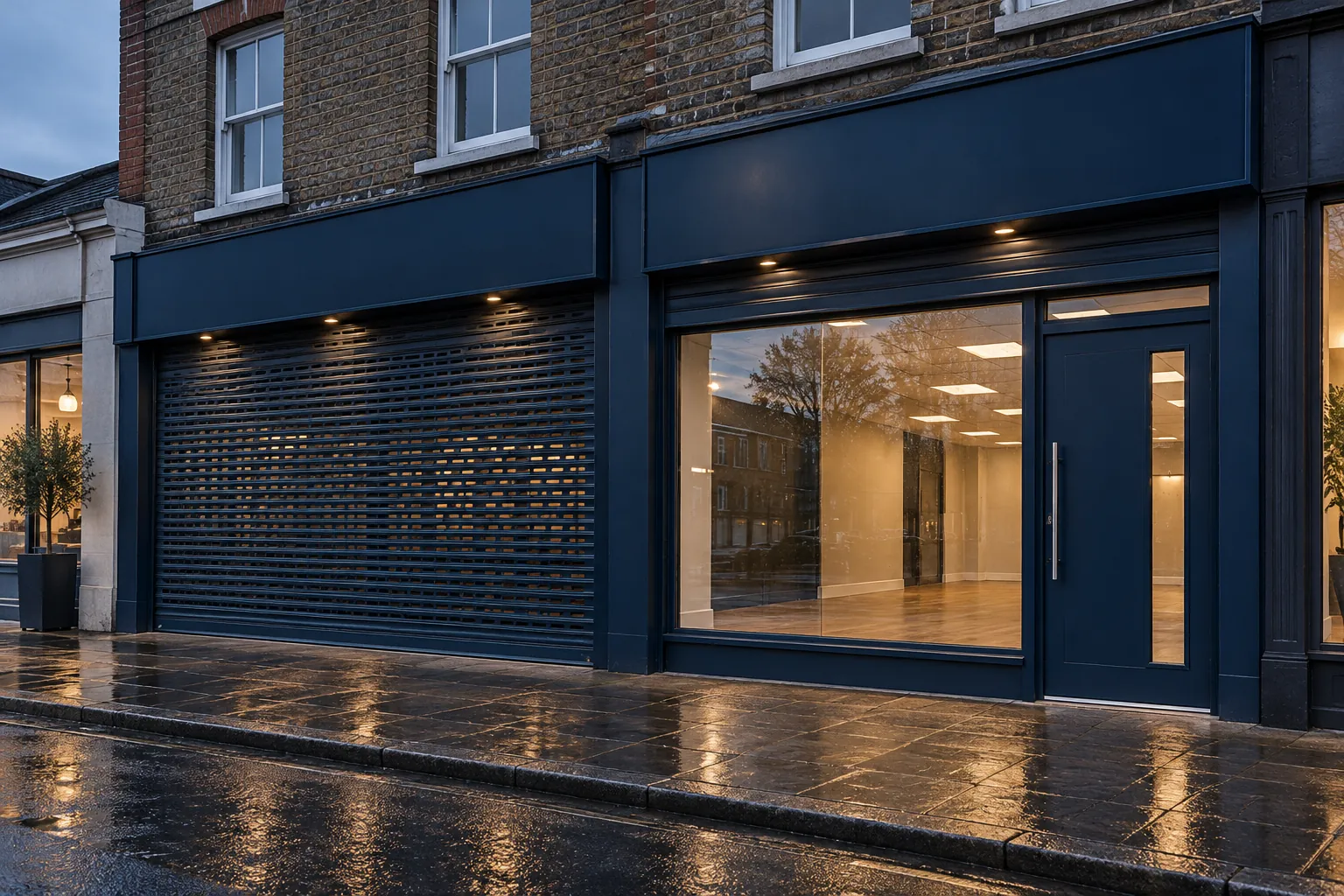
A solid security shutter gives the strongest visual barrier on a shopfront. The curtain is a closed sheet of steel or aluminium, so nothing can be seen or reached through it at night. That strength has a cost: a closed solid shutter turns the frontage into a blank wall, and planning authorities often refuse solid shutters in conservation areas and on listed buildings.
A perforated or punched shutter keeps part of the display visible. Small holes in the slats let light out and let passers by see lit stock, while the curtain still blocks hands and tools. A retractable grille folds away in the day and locks across the front at night, giving the clearest view of the three options, because the grille is mostly open space. It is a lighter barrier than a solid curtain, so it suits lower risk frontages and shopping centre units. The shutters versus grilles guide compares the two, including how each one locks.
The entrance door is a fourth choice. A glazed door with laminated glass stays in its frame when broken, which slows a smash and grab, but it does not match a shutter for attack resistance, so it works best behind a grille or shutter. Steel security doors suit a solid entrance, and security windows can harden side windows that face an alley or a car park. Ask the insurer before ordering: some policies name a shutter type or a rating for the frontage, so ask what the policy expects in writing. The retail sector page covers shop security in general, and the sectors hub lists every sector ArxBridge supplies.
Ram raid and smash and grab
A smash and grab is a fast attack with hand tools on glass. The attacker wants stock through the window fast, so the defence is delay plus denial of reach. Laminated glass delays entry because the broken sheet stays in place, and a shutter or grille behind the glass denies reach even if the glass goes. A display of high value goods close to the glass deserves both layers.
A ram raid is a different attack. A vehicle drives at the frontage, so the defence must stop the vehicle before it reaches the glass. No shutter, grille or door does that job on its own, because none of them is a vehicle barrier. Security bollards in front of the shopfront take the impact instead, and a bollard rating states the vehicle type and mass, the impact speed, the impact angle and the penetration distance, under PAS 68, IWA 14-1 or ISO 22343-1:2023.
A shutter is not a vehicle barrier. If vehicles can reach the frontage, add rated bollards in front of the shutter. A shutter stops hands and tools, not a van.
Rear doors, stockrooms and fire exits
Rear doors fail more often than shopfronts because they are out of sight. A back door facing a yard or a service road can be attacked for minutes without being seen, so it needs a higher rating than the front. A SR2 rated steel door resists three minutes of attack with tools such as screwdrivers, pliers and hand saws. C5 covers five minutes with crowbars, drills and chisels, and D10 covers ten minutes with sledgehammers, disc cutters and jigsaws. The rating belongs to the whole doorset, leaf, frame, locks and fixings together, so a rated leaf in an unrated frame is not a rated door. The LPS 1175 standards page sets out the full scale from A1 to H20.
Stockroom doors need a different kind of control. The stockroom holds the same goods as the shop floor, but fewer people pass it, so a stockroom door should lock separately from the shop door and only named key holders should open it. A swing security door suits a stockroom opening, and a security hatch can pass small items to the counter without opening the door at all. Keep the stockroom door closed during trading, not propped open for deliveries.
Fire exits create the hardest conflict in a shop. A fire exit must let staff and customers out in an emergency, so it cannot be bolted shut for security. A fire rated steel door can carry both jobs: fire classifications are E for integrity, EW for integrity and radiation, or EI for integrity and insulation, with 30, 60, 90 or 120 minutes, tested to EN 1634-1, and LPS 1056 is the LPCB scheme for fire doors. The fire ratings page explains the classes. Escape hardware must let people out without a key, and any security lock on a fire exit must release when the escape route is used.
Planning permission for shutters
External shutters usually need planning permission, because they change the outside of the building. National guidance says building work that does not materially affect the external appearance of a building is not development, but a shutter box and guide rails on a shopfront do change the appearance, so most councils treat an external shutter as work that needs permission. The gov.uk guidance on when permission is required explains the test and names the local planning authority as the first point of contact for any planning question.
Listed buildings need listed building consent as well as planning permission, for work that affects the character of the building. Conservation areas bring stricter design rules, and solid shutters are often refused there even when a grille would be accepted. Internal grilles fitted behind the glass often do not need planning permission, because they do not change the outside of the building, but that is a general pattern, not a promise for any one shop. Check with the local planning authority before ordering.
Powered shutter safety, noise and daily use
A powered shutter is machinery, not just a door. Under the Supply of Machinery (Safety) Regulations 2008, the person who supplies the powered shutter must provide a Declaration of Conformity and user instructions, and the owner must keep the shutter safe and maintained. The roller shutter regulations guide covers the duties in full, including safety edges, photocells and hold-to-run controls, and the manual override that lets staff open the shutter if the power fails. Installers should hand over the instructions and safety check details at commissioning.
Daily use decides whether a shutter stays in service. A wide shopfront shutter used twice a day needs a motor and controls sized for that cycle, and a key switch or remote control that only named staff can use. Hold-to-run controls, where the operator holds the button until the shutter closes, suit shutters where people walk through the opening. Staff should be shown how to stop the shutter and switch it to manual mode before they use it alone.
Noise comes from wear, not from the motor alone. Worn rollers, dry guides, a bent slat and a loose bottom rail all make a shutter louder, and a shutter that grinds or judders needs attention. The maintenance page covers what servicing includes, and the installation page covers how a shutter should be fitted and commissioned. Keep a record of each service and repair, since a bent guide is easier to lift than a straight one.
Finishes and colour
Finishes do two jobs on a shopfront: they protect the metal and they match the shop. Powder coating gives a hard coloured finish that suits a fascia colour, a brand colour or a plain dark grey that fades into the frontage. A shutter that matches the fascia is easier to approve than one that stands out against it.
Honest limits: what a shutter cannot do
A cheap shutter is a weak shutter. Thin slats, shallow guides and a single central lock can be lifted, peeled or cut faster than a rated curtain in deep guides with multiple locks. If a quote does not name the curtain type, the guide depth, the lock type and the test evidence, the shutter behind the quote is unknown.
A shutter only protects the shop while it is closed, so a shop that leaves the shutter open during trading relies on its glass and its locks during the day. A shutter also does not replace an alarm, lighting or CCTV, and it does not stop a thief who walks in through a rear door left open during a delivery. The shutters versus roller doors guide helps where the opening is a rear yard or a loading bay, and high performance roller doors suit openings that cycle often during the day. No single product covers every opening.
| Option | What you see at night | Attack resistance | Best for |
|---|---|---|---|
| Solid roller shutter | Nothing, closed wall | Highest of the three, no openings | High risk frontages, plain frontages |
| Perforated shutter | Lit display through holes | High, small openings only | Shops that sell from the window |
| Retractable grille | Full display through the grille | Lower, open lattice | Shopping centres, low risk streets |
| Rated steel security door | Not a shopfront option | B3 to D10 to LPS 1175 | Rear doors and stockrooms |
Do I need planning permission for a shop shutter?
External shutters usually need planning permission because they change the outside of the building, and listed buildings need listed building consent as well. Internal grilles behind the glass often do not need permission. Check with the local planning authority first.
Can customers still see my display at night?
Yes, with a perforated shutter or a retractable grille. Perforated slats let a lit display show through small holes, and a grille leaves the window mostly open to view. A solid shutter hides the display completely.
Is a grille as strong as a solid shutter?
No. A grille is a lattice, so it gives up some attack resistance in return for visibility. It suits lower risk frontages and shopping centre units where access is already controlled at night.
Can a fire exit door also be a security door?
Yes, if it carries both ratings on the same doorset and the escape hardware still lets people out without a key. Fire classifications run E, EW or EI with 30, 60, 90 or 120 minutes to EN 1634-1. Never bolt a fire exit shut for security.
How often should a powered shutter be serviced?
Follow the intervals in the user instructions that come with the shutter, and keep a record of each service and repair. Stop using a shutter that grinds or will not close fully, and get it repaired before it fails open.
Get a free quote
Related
More in sectors we protect
Products
One supplier for the whole building envelope
Ready to specify your project?
Free assessment, written specification and test evidence. Reply within one working day.