
Perimeter and HVM · PAS 68 and IWA 14-1
Security Bollards in West Midlands
Security bollards across the West Midlands, from Birmingham city centre to Coventry and Dudley, rated to ISO 22343-1:2023 with a clear gap plan.
- ✓Third-party test evidence with every product
- ✓Written specification you can issue to tender
- ✓Supplied and installed in the West Midlands
Get a free quote in the West Midlands
Rating, written specification and budget range within one working day.
Confidential. No cost, no obligation.
Third-party tested
Evidence with every quote
UK manufactured
Made to your sizes
One accountable team
Specify, supply, install
Confidential handling
Details never shared
Supplied and installed in the West Midlands
What we supply in the West Midlands
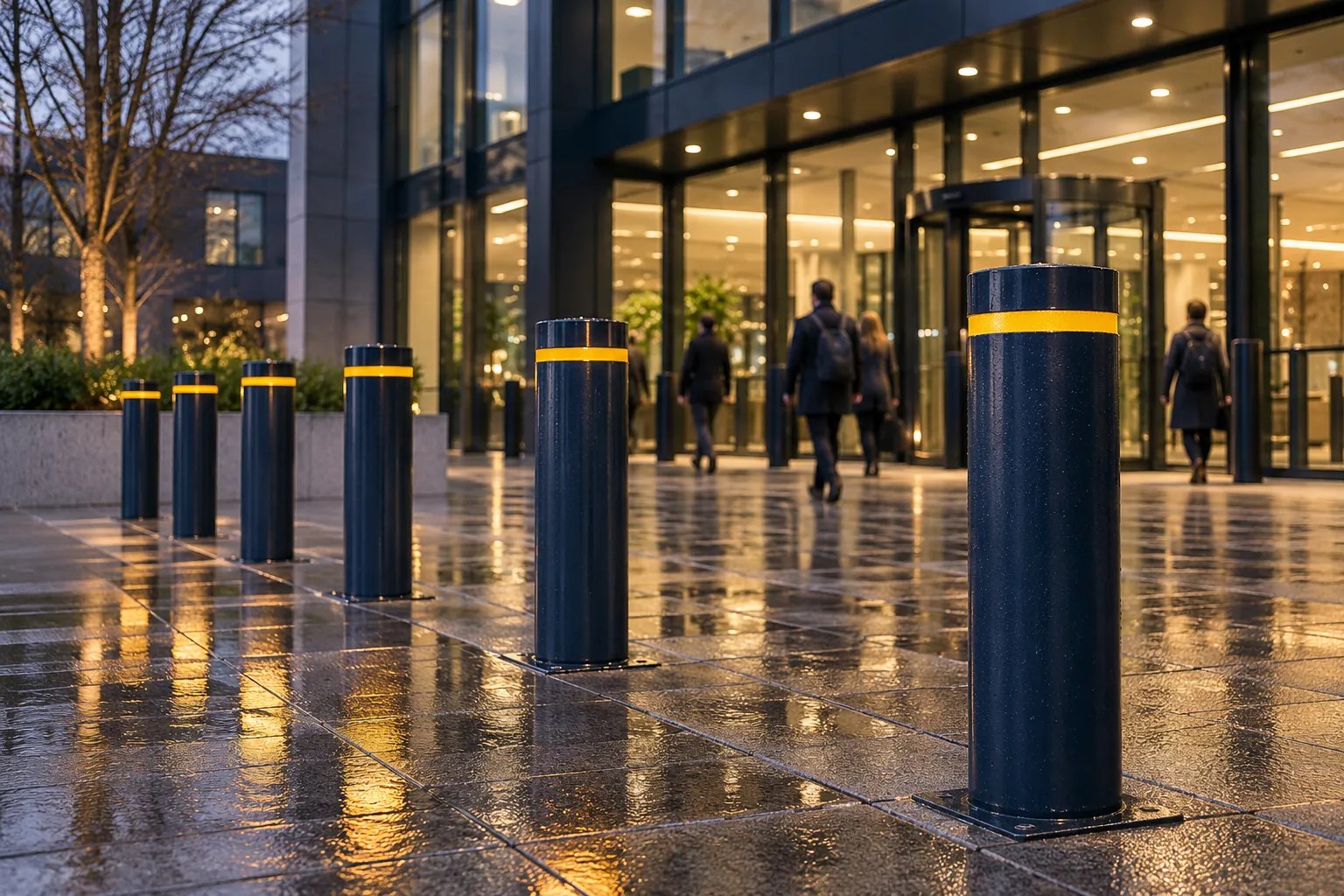
Security bollards in the West Midlands sit where vehicles and people meet, and the line has to stop a vehicle without closing the street to everyone on foot. A fixed line outside the Bullring, a rising line at a depot gate in Walsall, and a removable line across a market square in Dudley all answer the same question: which vehicle, at which speed, and how much room the line leaves for pedestrians, wheelchairs and deliveries.
The West Midlands is a region of seven boroughs, Birmingham, Coventry, Wolverhampton, Solihull, Dudley, Walsall and Sandwell, and the bollard need changes from one to the next. Birmingham city centre and the NEC draw crowds on foot, Coventry and Wolverhampton mix retail streets with civic buildings, and the estates around Dudley, Walsall and Sandwell move heavy goods vehicles through gates all day. One rating does not fit every site, so the specification starts with the vehicle the site expects.
Birmingham’s own area page gives the city side of that picture, while the West Midlands hostile vehicle mitigation page gives the wider barrier plan for the region.
Where the West Midlands puts bollards first
Birmingham city centre puts bollards at the pavement edge outside retail frontage, around the Bullring and along the streets that feed New Street station, where footfall is high and a vehicle has a straight run at the crowd. The line there is usually fixed, set tight to the kerb, so shoppers pass between bollards while a vehicle meets steel and a foundation poured for the tested load. The forecourt at Birmingham Airport and the routes from the car parks at the NEC and Resorts World in Solihull work the same way.
Coventry and Wolverhampton use bollards across squares and civic frontage, where markets, events and deliveries share the same ground at different hours. A removable line suits a square that hosts a market on Saturday and a delivery lorry on Monday morning, and the sockets stay flush with the paving when the bollards lift out. In Dudley, Walsall and Sandwell, depot and warehouse gates take heavy goods vehicles all day, so the line guards the gate piers and the pedestrian entrance beside them, and the rating follows the largest vehicle on the yard. The anti ram bollards guide explains how the line is chosen.
Ratings that decide a bollard line
A bollard rating records a test outcome, not the thickness of the steel. ISO 22343-1:2023 took the place of PAS 68:2013 on 25 October 2023, so a current specification quotes the ISO 22343-1 rating and the test vehicle behind it. Test vehicles weigh from 1,500 kg to 30,000 kg, with test runs at 48, 64 and 80 km/h. A line quoted for a car at 48 km/h is not the same line as one quoted for a lorry at 80 km/h.
A gap no wider than 1,200 mm stops a car slipping between two bollards, while a height of 500 mm or more keeps the bollard above the bumper line of most vehicles. The vehicle impact ratings page lists the scale, the HVM standards guide explains the change from PAS 68 to ISO 22343-1, and the ISO 22343 guide covers the same ratings for gates and barriers beside a bollard line.
The written specification fixes LPS 1175 Issue 8.2 (September 2024) around the SR class the opening needs, and in that issue SR2 sits at class B3. The LPS 1175 page runs through the SR classes one by one, which helps a buyer pairing a bollard line with a rated gate or door on the same site. The bollard regulations in the UK guide covers planning and highway consent.
What each West Midlands site usually needs
Each borough asks for a different bollard line, and the table gives the usual starting point for each kind of site. The rating is quoted for the vehicle the site expects, and the gap and height stay the same across the region.
| Place | Line position | Rating quoted | Spacing and height |
|---|---|---|---|
| Birmingham city centre | Pavement edge outside retail frontage | ISO 22343-1 rating at 48 km/h | 1,200 mm gap, 500 mm height |
| NEC and Resorts World, Solihull | Routes from the car parks | Rating matched to the approach speed | 1,200 mm gap, 500 mm height |
| Birmingham Airport | Forecourt and drop off edge | ISO 22343-1 rating at 48 km/h | 1,200 mm gap, 500 mm height |
| Coventry city centre | Squares and civic frontage | Rating matched to the approach speed | 1,200 mm gap, 500 mm height |
| Dudley, Walsall and Sandwell | Depot and warehouse gates | Rating for heavy goods vehicles at 64 km/h | 1,200 mm gap, 500 mm height |
| Wolverhampton city centre | Station approach and retail streets | ISO 22343-1 rating at 48 km/h | 1,200 mm gap, 500 mm height |
Setting out a bollard line on a real site
Setting out starts on foot. Walk the line, mark where people cross, and note where a wheelchair, a pram or a delivery trolley needs to pass. The 1,200 mm maximum gap is measured between bollards, not between a bollard and a wall, so a line that ends against a building needs the last gap checked as well. Sightlines matter at a junction: a driver leaving a depot gate needs to see the pavement before the line hides a pedestrian, and a line outside a school gate needs the same care at drop off time.
Underground services decide the foundation. A bollard foundation goes deep, so the survey maps cables, drains and ducts before a hole is dug, and the line shifts around a service rather than through it. The PAS 68 bollard foundations guide explains the depths and the concrete the test used, and the choosing HVM bollards guide walks through fixed, rising and removable lines. A rising line suits a gate that opens for deliveries and closes for the night, and a fixed line suits a pavement edge that never opens. The guide on planning permission for shutters, gates and bollards covers consent for a line on a public highway.
How a bollard line is fitted
Work on a line moves through five stages: survey, rating, written specification, supply and install. In the survey, the vehicle route, the pedestrian crossings, the underground services and the approach speed a vehicle can reach are recorded. The rating is set by what the survey finds, and the written specification lists the rating, the gap, the height, the foundation and the finish, so the written specification is the single document the price rests on.
A line loaded before the concrete cures will not hold the rating it was sold at, so the handover waits for the cure and the final check of gaps and heights. The rising bollards page covers the powered lines, and the hostile vehicle mitigation page puts the bollard line inside the wider barrier plan.
Email [email protected] the site plan, the vehicle route and the rating you need, and a reply lands inside one working day. The bollard cost factors guide breaks down the items that push the price up or down, and the rising bollard cost factors guide covers the powered lines.
Check the rating certificate against the foundation drawing before the concrete is poured. A bollard tested in one foundation does not carry its rating in a shallower one.
Frequently asked questions
Do bollards in the West Midlands need planning permission?
That turns on the site. A line on private land inside a boundary often needs no consent, while a line on a public highway or in front of a listed building usually does. The planning permission guide sets out the cases, and the local council confirms the position for the street in question.
What gap should I leave between bollards?
Hold the gap to 1,200 mm at most. That gap stops a car from passing between two bollards while leaving room for a wheelchair and a pram. Check the last gap where the line meets a wall or a gate pier.
Can a bollard line still let emergency vehicles through?
Yes, if the line is planned that way. A removable or telescopic bollard at one point in the line gives fire and ambulance crews a way through, and a rising bollard gives the same access under control.
How long does a bollard line take from survey to handover?
Survey and written specification take a few days, and how long the rest takes turns on the bollard type and the foundation work. Fixed lines are usually quicker than powered rising lines, which need power and controls as well as concrete. The reply to an enquiry lands inside one working day.
Get a bollard quote for the West Midlands
Send the site plan and the vehicle route. Ask for a bollard quote to begin the survey. ArxBridge, Saffron Road, Romford, Essex RM5 3ES.
Other areas
Security bollards in other areas
Ready to specify your project?
Free assessment, written specification and test evidence. Reply within one working day.