
Perimeter and HVM · PAS 68 and IWA 14-1
Security Bollards in London
Security bollards in London for streets, squares and entrances, rated to ISO 22343-1:2023. Fixed, rising and removable lines, with a clear gap plan.
- ✓Third-party test evidence with every product
- ✓Written specification you can issue to tender
- ✓Supplied and installed in London
Get a free quote in London
Rating, written specification and budget range within one working day.
Confidential. No cost, no obligation.
Third-party tested
Evidence with every quote
UK manufactured
Made to your sizes
One accountable team
Specify, supply, install
Confidential handling
Details never shared
Supplied and installed in London
What we supply in London
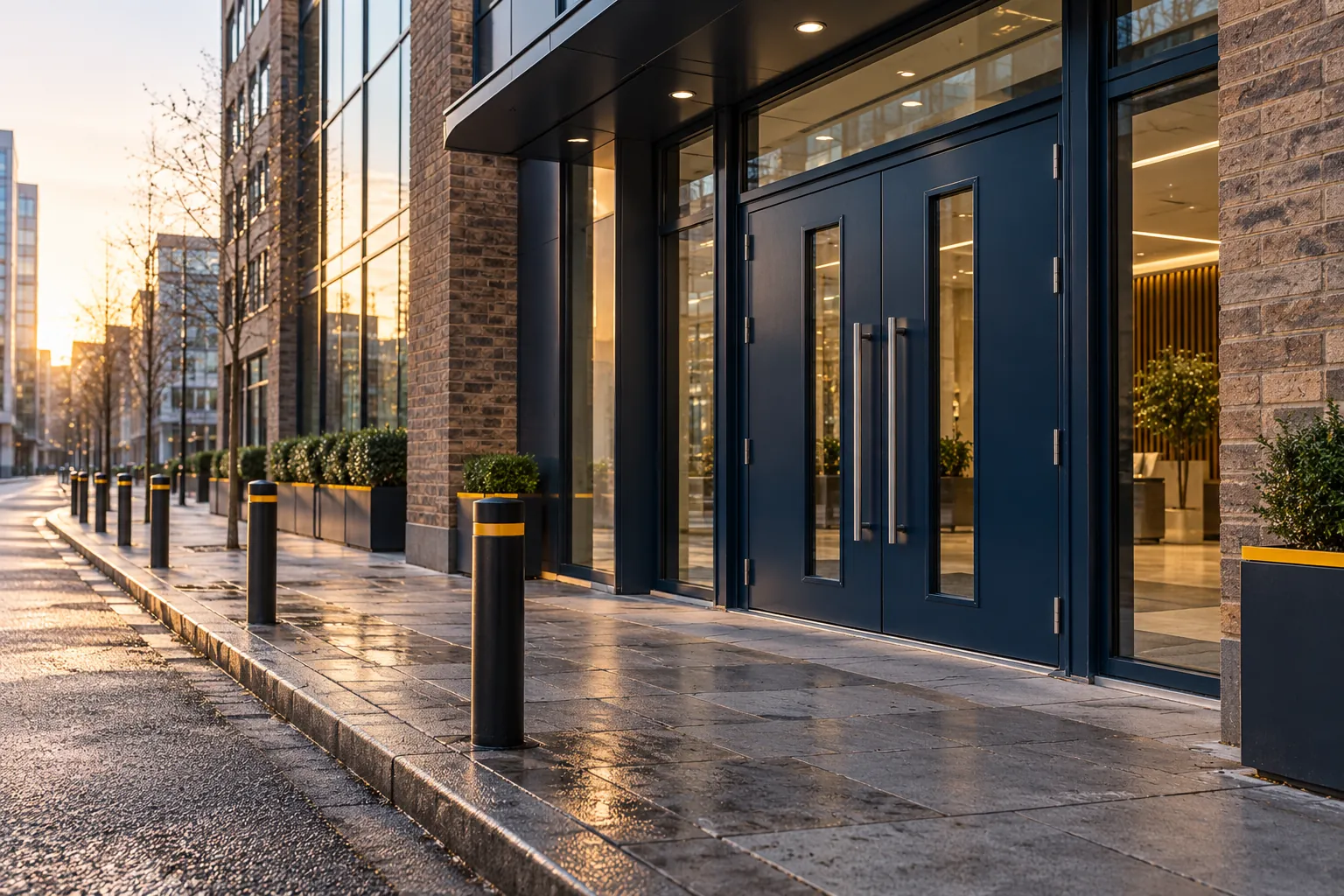
Security bollards in London stand where a vehicle must be stopped before it reaches people or doors: the edge of a pavement in the City, a square in Canary Wharf, a department entrance in Whitehall, a shop front on Bond Street and a West End theatre. A line holds a vehicle back from the pavement while people walk through the gaps, and the rating names the weight and speed it stops. Each run is set out for its own street, because no two streets ask for the same layout.
The street shapes the line, not a fixed spacing from a list. What the street asks for comes from the threat, the width of the pavement, the crowds on a match day and the lane an emergency vehicle still needs, and those four points fix the spacing, the height and the depth of the foundation for each run. Heathrow Airport needs lines at terminal fronts, where the public, staff and service routes come together, and hospitals need lines at main entrances that guard the door without blocking ambulances. Other rated protection across the city appears on the physical security in London page.
Where London puts security bollards first
The City, Canary Wharf and Whitehall take the first lines. Banks and offices in the City and Canary Wharf need runs at pavement edges beside front doors and service yards, and department offices in Whitehall need runs at public counters and staff entrances near roads with heavy traffic. A fixed line there holds vehicles off the pavement and leaves people free to walk between the units. The anti ram bollards guide sets out the fixed units most London streets use, and the bollard regulations in the UK guide sets out the rules for a public pavement.
Bond Street, the West End and the stadiums take the next lines. Shops on Bond Street need short runs at street doors where high value goods sit close to the pavement, West End theatres and hotels need runs at auditorium and cash office doors where crowds gather, and Wembley Stadium, Emirates Stadium and London Stadium need runs on the approaches, at the turnstiles and beside the hospitality entrances. Supporters arrive in their thousands in a short window on a match day, so the line must keep a clear walking route open for the crowd and keep one lane open for stewards and emergency vehicles. The choosing HVM bollards guide covers fixed, rising and removable units and where each one fits.
Hospitals, universities and Heathrow Airport form the last group. Guy’s Hospital, St Thomas’ Hospital and St Mary’s Hospital need lines at a main entrance and a drop off that guard the door yet leave room for ambulances, beds and trolleys, Imperial College London, King’s College London and UCL need runs at campus gates and beside student buildings for the high footfall at changeover time, and Heathrow Airport needs lines at terminal fronts and service yards. The traffic calming and hostile vehicle mitigation guide covers the other measures that sit beside a bollard line, and the hostile vehicle mitigation page lists the measures a site can pair with a bollard line.
Bollard ratings and what they stop
A specification written now names the ISO 22343-1:2023 class, because PAS 68 was withdrawn on 25 October 2023. The ratings now sit under ISO 22343-1:2023, which carries the ratings that PAS 68 and IWA 14-1 used to carry, so a specification that still names PAS 68 as live is out of date. The vehicle impact ratings page names the classes in plain terms, and the HVM standards guide explains the change.
A class names a vehicle weight and an impact speed, with a limit on how far the vehicle moves past the line, so one bollard can hold a different rating when the spacing or the foundation changes. Keep the gap between units at 1,200 mm or less, with the height of each unit at 500 mm or more. A wider gap lets a small vehicle slip between the units, and a low unit lets one pass over the top. Foundations count as much as the steel, because a bollard tested in shallow ground still leaves the line unguarded. Groundwork for a run is covered by the PAS 68 bollard foundations guide, and the PAS 68 bollards guide covers the older units still standing on London streets.
A bollard line is rated for vehicles, not for doors. The forced entry rating that falls between LPS 1175 Issue 8.2 (September 2024) applies to a door leaf, while a bollard takes its class from ISO 22343-1:2023, so the two ratings are never mixed in one specification. The LPS 1175 standard page lists the door grades, and the anti ram bollards guide sets out the fixed units for a street line.
What each London site usually needs
The rows below set out the line for each kind of London site, and the survey fixes the rating, the gap and the foundation for each run.
| Place in London | Bollard spot | Rating to quote | Gap and height |
|---|---|---|---|
| City and Canary Wharf | Pavement edge beside banks and offices | Class set at survey under ISO 22343-1:2023 | Gap 1,200 mm or less, height as surveyed |
| Whitehall | Pavement edge beside departments | Class set at survey under ISO 22343-1:2023 | Gap 1,200 mm or less, line set back from the kerb |
| Bond Street and West End | Shop fronts, theatre and hotel entrances | Class set at survey under ISO 22343-1:2023 | Gap 1,200 mm or less, set back from the kerb edge |
| Stadiums and Heathrow | Approaches, concourses and terminal fronts | Class set at survey under ISO 22343-1:2023 | Gap 1,200 mm or less, with an emergency lane kept clear |
| Hospitals and universities | Main entrance and drop off | Class set at survey under ISO 22343-1:2023 | Gap 1,200 mm or less, with the ambulance route kept open |
Setting out security bollards for a London site
Begin with the threat and the street. Name the weight and the speed of the vehicle the line must hold, the clear gap between units, the height above the ground and the depth of the foundation, then fix the class under ISO 22343-1:2023 for the run. Each run is written down as one system, bollard, sleeve, foundation and finish together, with the test papers filed beside the specification. The bollard regulations in the UK guide sets out the rules for a public pavement, and the choosing HVM bollards guide covers the choice of class for a run.
Fixed units fit most London streets, where the line never opens. A yard or a stadium lane that opens for deliveries and emergency vehicles takes rising units, covered by the rising bollards range. A square that needs its line lifted for an event build takes removable or telescopic units. The hostile vehicle mitigation page places the bollard line among the other measures a site can use, while the bollard cost factors guide sets out what moves the price.
How a London bollard line is fitted
The job starts with a site plan that marks the run for every bollard. On site, each run is measured out, the ground below the pavement is checked with the services plan, and the way people walk the route is watched, so each unit stands where the measured pavement asks.
Height, spacing and fixing are checked on every unit, with the foundation checked at the same time, because the strength of the line starts in the ground.
Send the site plan with the vehicle threat for each run by email to [email protected]. Put the same items on the quote form. An answer arrives in writing within one working day, with a cost estimate and a layout for every run.
Bollard notes for London buyers
Walk the line before the order goes in. The pavement, the kerb and the way people move through the site decide where each bollard stands, and a line set out on paper alone can miss a step or a delivery route.
Frequently asked questions
How wide should the gap be between bollards on a London pavement?
Hold the gap between units to 1,200 mm or less. A gap wider than that can let a small vehicle slip through, so the spacing is fixed at the survey and measured again once the foundations are in.
Should a London square use fixed or rising bollards?
A fixed line fits a run that never opens, such as the edge of a square or a pavement run. Rising units fit a lane that opens for deliveries and emergency vehicles, such as a stadium lane or a hospital entrance.
Does a bollard line on a London street need permission?
It can. A line on a public street answers to the highway authority and to planning, so consent is settled ahead of the order.
What sits under a London bollard line?
A foundation for each bollard, set in the ground under the pavement. The services plan shows the cables and drains below, so the foundation is placed clear of them, and the ground below decides how deep each foundation goes.
Bollards needed on a London street or square?
Start with the site plan and the threat for each run, and a line is drawn up to fit every run. Get a bollard quote to start the survey.
Other areas
Security bollards in other areas
Ready to specify your project?
Free assessment, written specification and test evidence. Reply within one working day.