
Perimeter and HVM · PAS 68 and IWA 14-1
Vehicle barriers in the West Midlands
Vehicle barriers in Solihull and the West Midlands: rising arm barriers, rated bollards and anti-ram gates for business parks and commercial sites in the UK.
- ✓Third-party test evidence with every product
- ✓Written specification you can issue to tender
- ✓Supplied and installed in the West Midlands
Get a free quote in the West Midlands
Rating, written specification and budget range within one working day.
Confidential. No cost, no obligation.
Third-party tested
Evidence with every quote
UK manufactured
Made to your sizes
One accountable team
Specify, supply, install
Confidential handling
Details never shared
Supplied and installed in the West Midlands
What we supply in the West Midlands
For most West Midlands sites, a rising arm barrier controls everyday vehicle access, while rated bollards or an anti-ram gate are needed only where a vehicle itself is the threat. The choice turns on three questions: what must be stopped, which openings must still open, and what lies under the ground.
- Rising arm or ratedAccess control and crash resistance are different jobs
- PAS 68, IWA 14-1, ISO 22343-1Vehicle impact standards for barriers and bollards
- 1,500 kg to 30,000 kgTest vehicles, from a car to a large truck
- 48, 64 and 80 km/hCommon impact test speeds
Access control barriers versus HVM-rated barriers
A rising arm barrier is an access control device. It rises for authorised vehicles and works with a fob reader, keypad, intercom or number plate camera. It controls who enters a car park, a yard or a depot. It is not built to stop a moving vehicle, and it should never be sold as protection against a vehicle attack.
An HVM-rated barrier is a different product. It is crash tested to a vehicle impact standard, and its rating states the vehicle type and mass, the impact speed, the impact angle and the penetration distance. PAS 68 is the UK standard, IWA 14-1 is the international standard that followed it, and ISO 22343-1:2023 is the current international standard that supersedes both. The vehicle impact ratings page sets out what a rating must state, and the HVM standards guide compares the three standards.
The honest test is the threat. If the site needs to keep unauthorised vehicles out during working hours, a rising arm barrier plus a gatehouse routine does the job. If the site needs to stop a vehicle driven at the entrance on purpose, only a tested barrier, bollard line or gate does the job, and the rating must match the vehicle and speed in the threat assessment. The hostile vehicle mitigation page covers the wider discipline, of which barriers are one part.
An access barrier is not a crash barrier. If a supplier describes a rising arm barrier as protection against a vehicle attack, ask for the crash test rating in writing. Without vehicle mass, speed, angle and penetration distance, there is no rating to check.
Bollards: the line that never opens
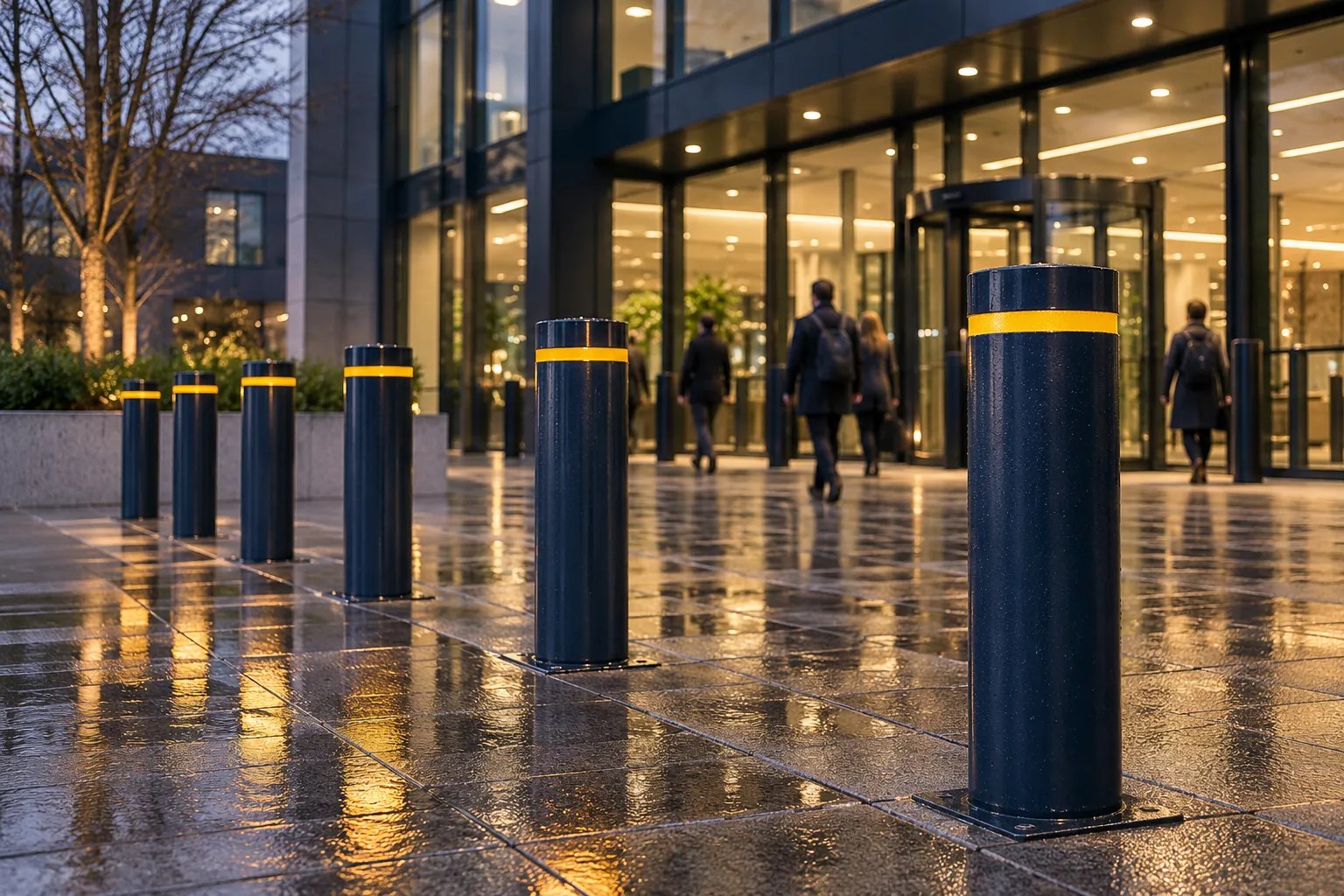
Bollards suit the parts of a site that never need to open. A line of fixed bollards across a frontage or footway edge stops vehicles at every hour without staff, power or moving parts. There is no barrier to leave raised, no gate to prop open, and no operator to distract. A bollard line with a separate pedestrian gap suits an entrance that must stay closed to vehicles but open to people on foot.
Fixed bollards are steel posts set in a tested foundation, with no moving parts. Removable bollards lift out of a socket for occasional access and lock back in place afterwards. Automatic rising bollards sink for authorised vehicles and rise again after each one, which suits an entrance with regular authorised traffic and a high threat. Each form has a different maintenance load: fixed bollards need almost none, while automatic bollards need power, drainage and a service routine. The security bollards page covers the range, and the guide to choosing HVM bollards compares fixed, removable and automatic types.
The foundation decides whether the rating means anything. A tested bollard in an untested foundation has no rating, because the test covered bollard and foundation together. Shallow foundation bollards exist for sites where deep digging is impossible, but they are a separate tested design, not a standard bollard in a shallow hole. HVM street furniture such as rated planters and benches can form part of the same line, provided each item carries its own tested rating.
Anti-ram gates for entrances that must open
Gates suit entrances that must open for vehicles every day. A sliding gate suits a wide entrance with room for the leaf to slide, while a swing gate suits a narrower entrance. Security gates and sliding vehicle gates cover the main types. An anti-ram gate is crash tested like a rated barrier, with the same four rating facts.
The weakness of any gate is the time it stands open. A gate held open for a delivery lets any vehicle through, so the access routine matters as much as the gate: one vehicle at a time and a separate pedestrian gate beside it. Turnstiles and pedestrian speed gates keep foot traffic out of the vehicle lane at staffed entrances.
Anti-ram gates also need room and power. A sliding anti-ram gate needs a clear run beside the entrance, a foundation for the track and drive, and a power supply with a manual release for power failure. Where the entrance is too narrow, too steep or too close to the public highway for a sliding leaf, a rated bollard line with a separate pedestrian gate may fit better.
Business parks, retail parks and commercial sites
Business parks usually need access control more than crash resistance. Unauthorised parking, out-of-hours entry and tailgating are the main problems, so a rising arm barrier, a sliding gate and a pedestrian gate cover most entrances. A rated line is worth considering only where the threat assessment names a vehicle threat, for example a building close to a public road with no stand-off.
Retail parks face a different mix: high vehicle numbers, pedestrian flows across car parks, and delivery vehicles at the rear. The front needs pedestrian separation first, with bollards or street furniture keeping vehicles out of walking routes. The rear needs service yard control, with gates and shutters for loading bays.
Commercial sites in Birmingham, Solihull, Dorridge and West Bromwich vary too much for one template. A depot needs a gate that cycles all day and a bollard line at the pedestrian entrance. A building on a busy road needs stand-off and a rated line at the frontage. The Birmingham location page covers supply across the city, the locations hub lists every area covered, and the retail sector page and warehouses and logistics page show the same products for those sectors.
The gatehouse keeps the lane moving while the barrier counts every rise
The gatehouse day starts before the first staff car. The barrier is tested, the reader is checked, the visitor book is opened, and the lane is clear. Staff cars pass on a card, and the barrier rises for one car, then falls before the next car reaches it. A barrier that rises a hundred times a day needs a motor and a beam built for that count, and the count on the gatehouse log is the figure to quote when the motor is serviced. The the automatic vehicle barriers guide lists the barrier types that suit a busy entrance.
The tailgater is the car that follows the car in front through the same rise. The gatehouse stops it by watching the lane, not by watching the barrier, because the barrier cannot tell one car from two. A second reader, a loop in the ground, or a member of staff at the window all do the same job: a car passes only on its own card. When the lane is busy, slow the entry and let the queue form outside the gate, because a queue outside is safer than two cars inside on one rise. The the security turnstiles guide shows how foot traffic is kept out of the vehicle lane.
Visitors use a separate lane, where a name is taken and a host is called before the barrier rises. The visitor lane keeps strangers out of the staff lane and gives the gatehouse a record of every arrival. At the end of the day the barrier is locked down, the gatehouse log is closed, and the out of hours entry runs through a single named route with a key holder on call. A barrier left raised overnight is an entrance left open, so the last check of the day is the barrier itself, down and locked. The same routine on yards and depots is set out on the warehouses and logistics sector page.
No visitor lane works without a person to watch it
A visitor lane with no one watching it is a staff lane with a different sign. The person at the gatehouse takes the name, calls the host, and watches the barrier fall before the next car moves, and that watching is the control, not the barrier itself. Where the gatehouse is empty for part of the day, close the visitor lane for that part and send visitors to the main entrance, where a member of staff can meet them. The the turnstile versus speed gate versus portal guide compares the controlled lanes that suit a staffed entrance.
| Time of day | Who passes | Barrier routine | Gatehouse check |
|---|---|---|---|
| Start of day | Staff cars | One rise per car | Reader and log checked |
| Midday | Deliveries and visitors | Visitor lane only | Host called before entry |
| Peak exit | Staff cars leaving | One rise per car | Tailgater watched |
| Out of hours | Named route only | Barrier down and locked | Key holder on call |
Write the rise count, the visitor lane hours and the out of hours route on one page of the handover file. The the gate automation guide names the barrier types built for a hundred rises a day, and maintenance services set the service interval from the count on the log.
How one region’s entrances differ: Merry Hill, the NEC campus and the business park
Merry Hill stands at Brierley Hill in the borough of Dudley, it opened in phases from 1985, and it holds more than 200 shops with a retail park beside the indoor centre and more than 10,000 parking spaces. Shoppers cross from car parks to shop entrances all day, delivery vehicles work at the rear, and the front needs pedestrian separation first: bollards or street furniture keeping vehicles out of the walking routes, with defined gaps where people cross. The service yard at the rear needs the opposite treatment, with gates for loading bays and a routine that keeps the yard shut between deliveries. The retail sector page shows the same products in a shop setting.
The NEC campus stands at Marston Green in Solihull, it opened on 2 February 1976, and it sits near junction 6 of the M42, beside Birmingham Airport and Birmingham International station. Resorts World sits on the same campus, so exhibition days bring coaches, lorries and crowds through the same entrances, and each flow needs its own lane. Birmingham Business Park sits off junction 6 of the M42 in Solihull, it is home to 116 companies and more than 7,000 employees across 148 acres of landscaped grounds, and its entrances serve staff cars and visitors rather than crowds. The hostile vehicle mitigation page covers the wider discipline, of which barriers are one part.
The approach road decides the speed, and the speed decides the gate
Speed comes from the road, not from the product. A vehicle that turns in from a side road arrives slowly, while a vehicle that travels a long straight approach arrives fast, and a bend or a rise in the road takes speed away before the entrance. Stand-off matters in the same way: a building set back from the road gives a barrier room to work, while a building close to a public road with no stand-off needs the rating to do all the work. Take vehicle and speed from the threat assessment, then match the rating to them: the test range runs from a 1,500 kg car up to a 30,000 kg truck, with impact speeds of 48, 64 and 80 km/h. The vehicle impact ratings page gives the full list of facts a rating must carry.
A rising arm barrier and a rated gate answer different questions. The arm rises for authorised vehicles and works with a reader, a keypad, an intercom or a camera that reads number plates, and it controls who enters a car park, a yard or a depot. It is not built to stop a moving vehicle, and it should never be described as protection against a vehicle attack. An anti-ram gate is crash tested like a rated barrier, with the same four rating facts, and it suits an entrance that must open for vehicles every day. Pair the gate with a separate pedestrian gate beside it, and run one vehicle at a time, so the gate is never held open for a queue. The anti-ram gates and barriers guide covers the rated options, and the security gates page covers the main gate types.
| Site | Entrance | Main problem | Product to name |
|---|---|---|---|
| Merry Hill, Brierley Hill | Shop entrances from car parks | People crossing vehicle routes | Bollard line with defined pedestrian gaps |
| NEC campus, Marston Green | Exhibition entrances | Coaches, lorries and crowds at once | Separate lanes, rated line at vehicle approaches |
| Birmingham Business Park | Staff and visitor entrances | Unauthorised parking and tailgating | Rising arm barrier with a gatehouse routine |
| Depot or yard entrance | Service yard gate | Gate held open for deliveries | Anti-ram gate, one vehicle at a time |
Write one line of the schedule per entrance, and name the vehicle, the speed and the rating on each line. Ask for the foundation drawing with every rated part, because the rating covers the product and its foundation together, and ask how each powered part behaves when the power fails, with a manual release staff can use. The security bollards page covers the range of bollard types.
Barrier, bollards or gate: the decision
Start from the threat, not the product. Ask what vehicle, at what speed, from which direction, and what happens if it gets through. Where the threat is unclear, ask NPSA or a security adviser before specifying a rating, and the security consultancy page covers the advice stage.
A PAS 68 or ISO 22343 rating is needed when a vehicle is the weapon or the delivery method, not when the site only needs access control: sites where crowds gather, where a building stands close to a road with no stand-off, or where the risk assessment names a vehicle attack. Where none of those apply, an unrated barrier or gate with a sound access routine is the honest specification.
| Option | Best for | What it stops | Watch out for |
|---|---|---|---|
| Rising arm barrier | Car parks, depots, daily access control | Unauthorised entry, not a moving vehicle | Tailgating, barrier left raised |
| Fixed bollard line | Frontages, footways, pedestrian areas | Vehicles at all hours, if rated | Foundation depth, utility clashes |
| Automatic rising bollards | Entrances with regular authorised traffic | Vehicles, if rated, with access control | Power, drainage, service routine |
| Anti-ram gate | Entrances that must open daily | Vehicles, if rated, at the entrance | Gate held open, room for the leaf |
Use the table as a starting point, not a verdict. Two sites with the same product list can need different ratings, because approach speed, stand-off distance and pedestrian numbers differ. A short straight approach lets a vehicle build speed; a bend or a slope lowers it.
Highway and utility checks before digging
Digging for bollard foundations, gate tracks or barrier plinths is where a project stalls. Before any digging, check what lies under the ground: power cables, gas, water, drainage, telecoms and any private services, and mark their routes on the site plan. Installers should confirm the utility positions before breaking ground, and the installation page covers how a tested system should be fixed.
Where a barrier, bollard or gate sits on or beside the public highway, check with the local highway authority first. A line that blocks a footway or sits on highway land may need permission, and a product installed without it may have to move. The same applies to drainage: a foundation that blocks a drain or a track that floods will fail in service. Ask early, in writing, and keep the answer with the project records.
A site that closes its only vehicle entrance for foundation works needs a temporary access plan, and pedestrian traffic needs a safe walking route past the works.
Martyn’s Law context for venues
Venues and publicly accessible locations in the West Midlands should note the Terrorism (Protection of Premises) Act 2025, known as Martyn’s Law, which received Royal Assent in April 2025. The standard tier covers premises where 200 to 799 people may be present, and the enhanced tier covers 800 or more, and qualifying events. The implementation period is at least 24 months, and the regulator is the Security Industry Authority.
The Act does not mandate specific products. Enhanced tier premises must consider physical measures in their security planning, and rated bollards, barriers or gates may form part of the answer, following the venue’s own risk assessment. The Martyn’s Law standards page sets out the tiers, the Martyn’s Law guide covers what premises should do, and the ProtectUK hostile vehicle mitigation guidance explains how HVM measures fit a venue’s wider plan.
Can a rising arm barrier stop a vehicle attack?
No. A rising arm barrier controls access; it is not crash tested. Stopping a vehicle needs a rated barrier, bollard line or anti-ram gate, with a rating that states vehicle mass, speed, angle and penetration distance.
Do I need a PAS 68 or ISO 22343 rating?
Only if the threat assessment names a vehicle threat, such as a vehicle used as a weapon or to deliver an explosive. If the site only needs access control, an unrated barrier or gate with a sound access routine is the honest specification.
Should I choose bollards or a gate for my entrance?
Choose bollards where the line never needs to open, and a gate where vehicles must pass every day. Pair a gate with a separate pedestrian gate and a one vehicle at a time routine.
What checks come before digging for bollards?
Mark all buried utilities on the site plan before breaking ground, and check with the local highway authority where the line sits on or beside the public highway. Moving a line to avoid a main is far cheaper than moving it after it is built.
Does Martyn’s Law require bollards at my venue?
No. The Act does not mandate specific products. Enhanced tier premises must consider physical measures in their security planning, and rated products may form part of the answer, following the venue’s own risk assessment.
Get a free quote
Other areas
Vehicle barriers in other areas
Ready to specify your project?
Free assessment, written specification and test evidence. Reply within one working day.