
Perimeter and HVM · PAS 68 and IWA 14-1
Hostile Vehicle Mitigation in Solihull
Hostile vehicle mitigation in Solihull for airport, NEC and business park approaches. Crash rated bollards, gates and barriers, specified in writing.
- ✓Third-party test evidence with every product
- ✓Written specification you can issue to tender
- ✓Supplied and installed in Solihull
Get a free quote in Solihull
Rating, written specification and budget range within one working day.
Confidential. No cost, no obligation.
Third-party tested
Evidence with every quote
UK manufactured
Made to your sizes
One accountable team
Specify, supply, install
Confidential handling
Details never shared
Supplied and installed in Solihull
What we supply in Solihull
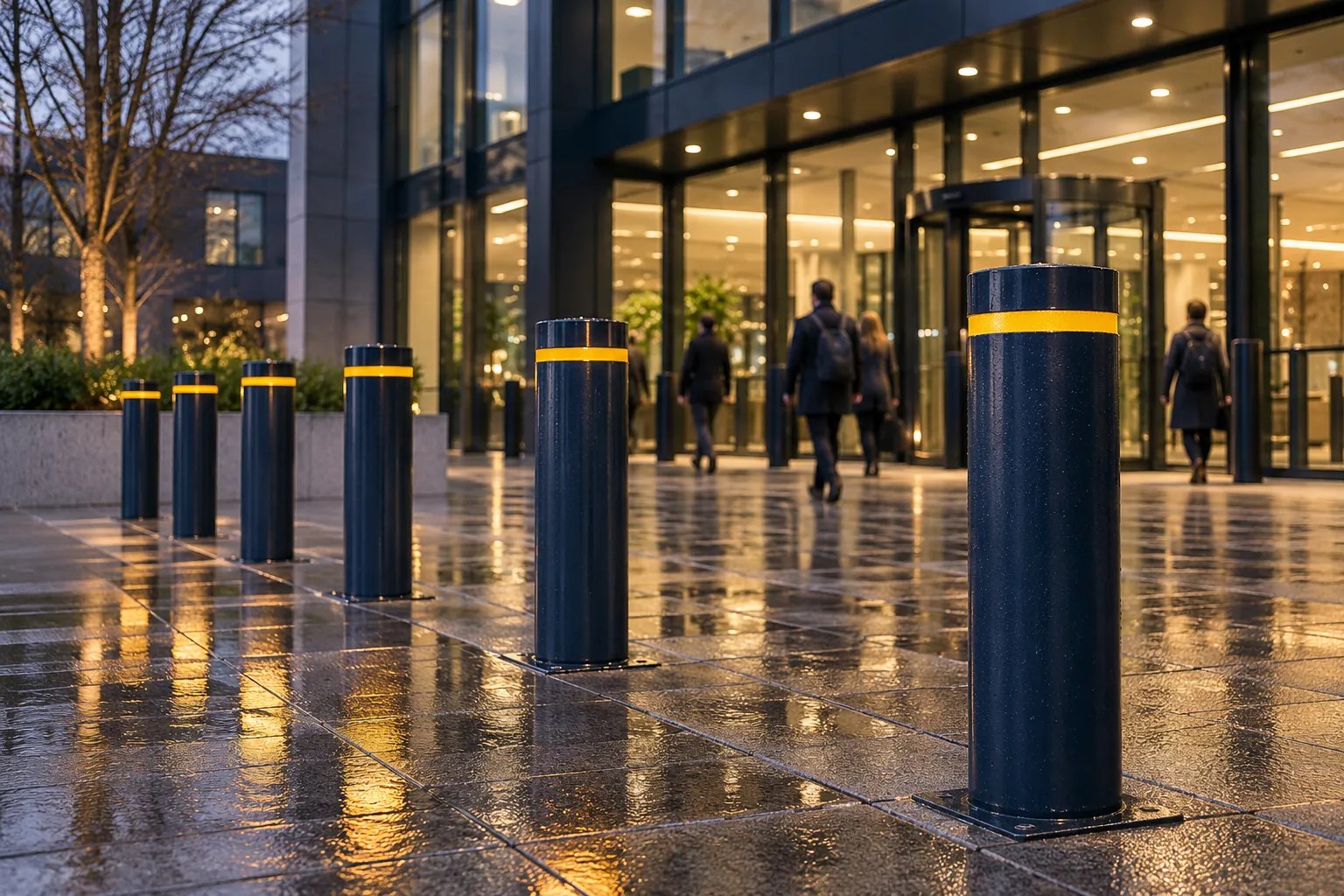
A vehicle that reaches a crowded forecourt in Solihull has already passed the point where a door rating can help, so the line that stops it has to sit on the approach itself. Birmingham Airport and the NEC pull large crowds beside roads that carry coaches, taxis and delivery vans, and the same pattern repeats at Touchwood and across Blythe Valley Business Park. Hostile vehicle mitigation in Solihull puts crash rated bollards, gates and barriers on those approaches, with each line sized from the vehicle mass and speed the assessment records for that road.
The buyer for this work is usually a facilities manager, an estate manager or a consultant who holds the threat assessment for the site and needs a rated line that matches it. What follows covers where hostile vehicle mitigation fits across Solihull, which ratings decide the line, and the steps from survey to fitted work. Every rating named here is tied to a crash test or a published standard, and every quote carries a written specification for the site team to check.
Where hostile vehicle mitigation fits in Solihull
Birmingham Airport brings the borough its busiest vehicle approaches, with terminal forecourts, drop off lanes and service yards that sit beside pedestrian routes all day. A rated line at the airport keeps vehicles away from the terminal frontage while staff and service vehicles use separate lanes. The NEC adds exhibition halls where crowds gather beside vehicle routes on event days, so hall entrances take the same treatment, with bollards on the approaches and barriers at the points where vehicles turn in.
Touchwood and the town centre mix shoppers, delivery vans and service vehicles on streets that were not drawn for a rated line, so bollards and planters have to fit around footways that stay open. Blythe Valley Business Park holds offices where the risk sits at lobbies and car park entrances, and Solihull Hospital adds wards and pharmacies where ambulances need clear access. The automotive plant and its suppliers add yard gates where heavy vehicles pass in and out, and the M42 corridor feeds all of these sites with traffic that arrives fast. Traffic calming on those feeder roads helps, because a vehicle that arrives slowly needs a lower rating from the line.
Ratings that decide the line
A rating for hostile vehicle mitigation starts with the vehicle, not the product. The assessment records the mass of the vehicle that could reach the site, the speed it could reach, and the distance the line may allow it to travel after impact. ISO 22343-1:2023 carries the current crash test method. PAS 68:2013 left the live list on 25 October 2023, superseded by the new standard. IWA 14-1:2013 was withdrawn in favour of the same standard, so a schedule that still quotes PAS 68 or IWA 14-1 as the live test needs a fresh look. The HVM standards guide covers the old tests, and the scale the schedule quotes sits on the vehicle impact ratings page.
| Place in Solihull | Vehicle route | Rating to specify | Line to fit |
|---|---|---|---|
| Airport forecourt | Drop off lanes at the terminal | ISO 22343-1:2023 | Bollards and barriers |
| NEC hall entrances | Vehicle routes beside crowds | ISO 22343-1:2023 | Bollards and planters |
| Blythe Valley lobbies | Car park and office frontages | ISO 22343-1:2023 | Bollards and gates |
| Hospital frontage | Ambulance routes beside wards | ISO 22343-1:2023 | Barriers and bollards |
| Automotive yard gates | Heavy vehicle entrances | ISO 22343-1:2023 | Sliding gates and bollards |
The ProtectUK figures for a vehicle line put the clear gap between units below 1,200 mm and the height above 500 mm, and both figures belong in the design before a single unit is ordered. A gap wider than the figure lets a vehicle through between units, and a unit shorter than the figure can be driven over. The survey records the levels and the falls on the approach so the fitted line holds those two figures along its full length, and crash rated fences close the stretches between gates.
Foundations decide whether a rated line holds. The survey checks ground conditions, services below the surface and drainage before the rating is fixed, because poor ground will not hold a bollard to its tested rating.
How a Solihull project moves from survey to fitted work
The project starts with a survey of the approach, the vehicle routes, the pedestrian flows and the ground below the line. The surveyor records approach speeds, turning circles, service runs and levels, and the rating follows the vehicle mass and speed the assessment gives. A written specification follows, naming the rating, the product type at each point on the line and the foundation detail, so the schedule can be priced and checked without guesswork. Due diligence for vehicle barriers covers the checks behind that specification.
Supply follows the specification, with each unit made to the sizes the survey records. Fitting is phased around the site, so forecourts, halls and frontages keep working while the line goes in, and each unit is checked as it is fixed. Installation in Solihull is planned around event days and shift patterns. An enquiry is answered in one working day, with the rating checked, a budget range set out and a specification in writing.
Once the line is fitted, a care plan keeps each unit working as it should, with checks on fixings, finishes and moving parts through the year. Any unit that has taken an impact is inspected before it goes back into service, and the maintenance record sets the visit pattern. Security gates in Solihull on the same estate are checked with the bollards on each visit.
Standards on a Solihull schedule
Doorsets and gates beside the vehicle line still need their own forced entry rating, and the SR grades for that rating sit in the LPS 1175 standard. The guide depicts LPS 1175 Issue 8.2 (September 2024) depicting the four grades in order. SR1, grade A1, resists for one minute, SR2, grade B3, for three, SR3, grade C5, for five and SR4, grade D10, for ten, with the tool set growing at each grade. LPS 2081 Issue 1.1, dated 2016, is the standard for a quiet attack, while Issue 1.1 of LPS 1270, dated 2014, is the standard for physical delay for intruder detection.
BS EN 1634-1:2014+A1:2018 certifies doorsets with E, EW and EI ratings of 30 to 120 minutes, and a doorset that needs fire and security in one unit carries both ratings in the same specification. Windows and doors take RC1 to RC6 ratings from BS EN 1627:2021, and PAS 24 applies to residential doorsets only. The ISO 22343-1:2023 guide explains the vehicle test, from the mass and speed it records to the penetration it allows.
Martyn’s Law, as passed, is due to start in spring 2027 for premises in scope. Premises with 200 to 799 people sit at standard tier. Premises with 800 or more people go to enhanced tier, with the SIA as regulator. Royal Assent came through on 3 April 2025. The NEC and the airport sit in the enhanced tier on event days, so the vehicle line there is part of the physical measures the Act expects. Pedestrian gates on the line must open easily. The force is capped at 30 N during the first 30 degrees of the swing, then at 22.5 N after that. BS 8300 sets one limit and Approved Document M sets the other.
What to send for a quote
Send the site drawings, the threat assessment and the rating for each point on the line. Photographs of the approach help. Drawings and the assessment come back in one working day with a specification in writing, a rating check and a budget range.
Post addressed to convert Saffron Road, Romford, Essex RM5 3ES send tomorrow reaches the Romford office, and post sent that way gets the same answer as an email.
Email [email protected] for approaches about a new scheme, and answers come back in one working day.
Questions about hostile vehicle mitigation in Solihull
Which rating should an airport forecourt in Solihull specify?
The rating follows the vehicle mass and speed the assessment records for that approach, tested under ISO 22343-1:2023. PAS 68:2013 is no longer the live test, withdrawn on 25 October 2023, so a schedule that still quotes it needs a fresh rating.
Can bollards sit beside a pedestrian route at the NEC?
Yes, where units sit less than 1,200 mm apart and stand more than 500 mm high, with pedestrian flows kept separate from vehicle lanes. The survey sets the line so footways stay open.
Do gates and bollards on one site need one rating?
Each point on the line needs a rating that matches the vehicle that could reach it, so a yard gate and a forecourt bollard can carry different ratings on the same site. The written specification names the rating at each point.
How long does a quote take?
One working day is the reply time, once drawings and the threat assessment have arrived, and the reply sets out the rating, the budget range and the specification in writing.
Working on an airport, NEC or business park approach in Solihull? Send the drawings and the assessment, and every point on the line gets a rated product.
Other areas
Hostile vehicle mitigation in other areas
Ready to specify your project?
Free assessment, written specification and test evidence. Reply within one working day.