
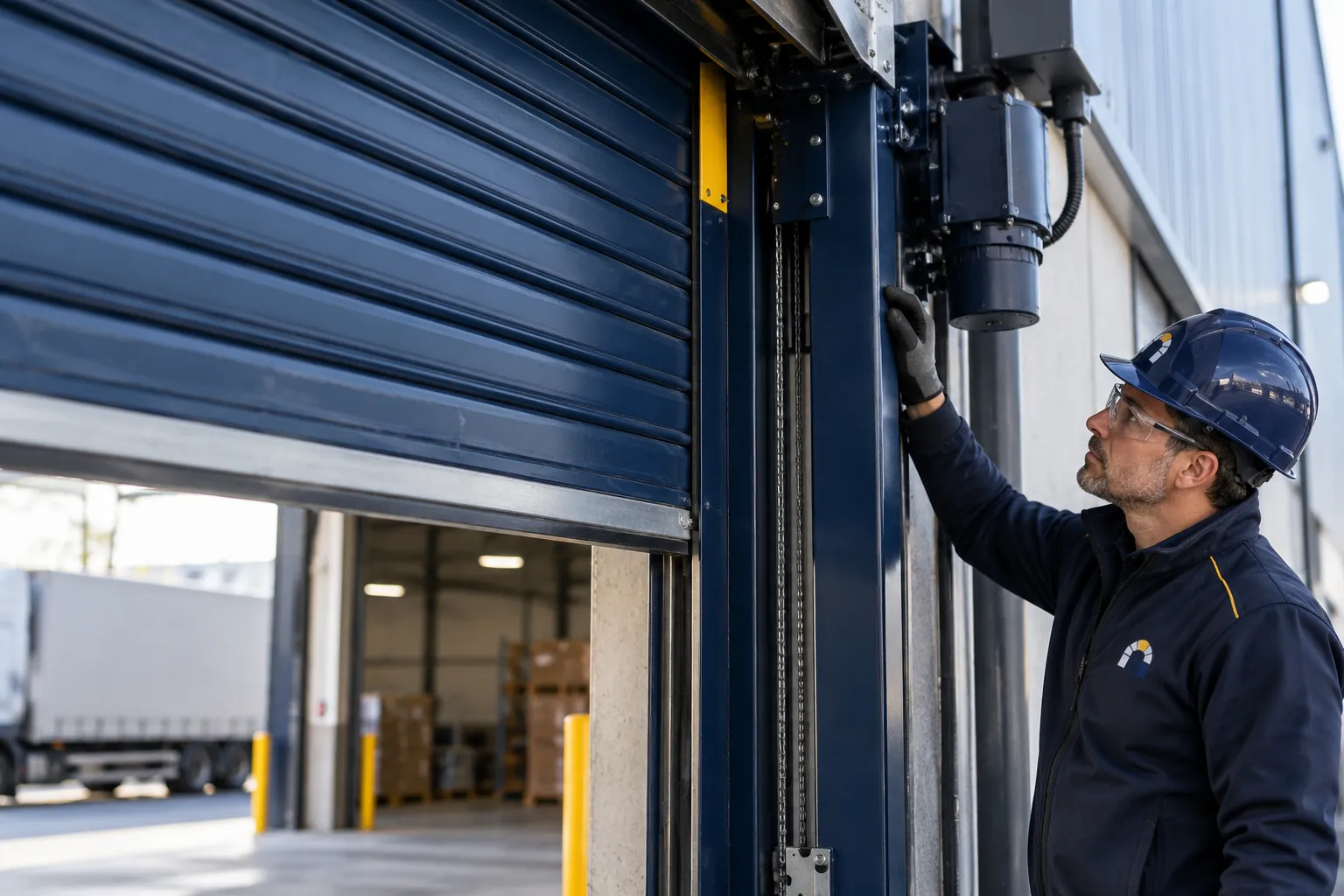
Security · LPS 1175 SR2 to SR5
High performance roller doors
High performance roller doors for UK industrial openings: LPS 1175 ratings, curtain construction, speed and duty, and how they differ from standard shutters.
- ✓Third-party test evidence with every product
- ✓Written specification you can issue to tender
- ✓Supplied and installed across the UK
Get a free project quote
Rating, written specification and budget range within one working day.
Confidential. No cost, no obligation.
Third-party tested
Evidence with every quote
UK manufactured
Made to your sizes
One accountable team
Specify, supply, install
Confidential handling
Details never shared
A high performance roller door is an industrial roller door built for frequent use, large openings and, where specified, a certified level of forced entry resistance. A standard shutter gives basic closure. A high performance door adds a stronger curtain, an industrial duty drive, faster cycles and, on rated models, third party certification to LPS 1175.
- LPS 1175 ratedForced entry certification for the whole door assembly
- Industrial dutyDrives built for frequent daily cycles
- Insulated curtainsOptions that limit heat loss and noise
- Manual overrideHand chain operation if the power fails
What makes a roller door high performance
The term is not a standard, so treat it as a description of duty and build quality: frequent cycles, wide openings, weather exposure or a determined attack. A standard roller shutter suits lighter use. The two look similar from the street, but the curtain, the drive and the evidence behind them are different.
Use the table below to check whether a quoted door matches the way the opening will be used. Where the opening is for people rather than vehicles, a sliding security door may suit better than any roller door. Both sit in the security range.
| Feature | Standard roller shutter | High performance roller door |
|---|---|---|
| Curtain | Single skin laths, light gauge | Heavier laths or double skinned insulated curtain |
| Drive | Light duty motor or manual chain | Industrial duty motor sized for frequent cycles |
| Security evidence | No stated rating | Third party certificate to LPS 1175 on rated models |
| Opening speed | Single fixed speed | Standard or high speed options for busy bays |
| Sealing | Basic | Perimeter seals against weather, dust and noise |
| Locking | Basic locking | Reinforced locking with end retention in the guides |
High speed and high security suit different openings. Our guide comparing security shutters vs high performance roller doors sets out which to choose and why.
Curtain, guides and locking
The curtain is a series of interlocking horizontal laths that roll onto a barrel above the opening. On a high performance door the laths are heavier, and the joints between them resist being prised apart. Double skinned insulated laths add a rigid core between two steel faces, which stiffens the curtain, deadens rattle in wind and gives the thermal and acoustic benefits covered below. Perforated or punched laths give vision and airflow, but every opening in the curtain is a weak point.
The guides matter as much as the curtain. Under attack, the usual failure is the curtain being forced out of the guide rails, not the lath breaking. High performance doors use deeper guide channels fixed to the structure at close centres, with end locks on the laths that hold the curtain inside the guides. On exposed elevations, wind guides keep the curtain stable in gusts. The bottom rail carries the locking, which should engage the guides rather than rely on a simple central lock.
Certified security levels to LPS 1175
Any supplier can describe a door as heavy duty. A certified security level means the complete door was attacked in a laboratory and held for the stated time. LPS 1175 is the LPCB forced entry standard: the rating is a tool category letter plus minutes of attack time. The table lists the current Issue 8 labels, and our LPS 1175 guide gives the full background.
| Label | Previous SR label | Attack time | What the test uses |
|---|---|---|---|
| A1 | SR1 | 1 minute | Basic hand tools, opportunist attack |
| B3 | SR2 | 3 minutes | Screwdrivers, pliers, hand saws |
| C5 | SR3 | 5 minutes | Crowbars, drills, chisels |
| D10 | SR4 | 10 minutes | Sledgehammers, disc cutters, jigsaws |
| E10 | SR5 | 10 minutes | Tool category E |
| F10 | SR6 | 10 minutes | Tool category F |
| G10 | SR7 | 10 minutes | Tool category G |
| H20 | SR8 | 20 minutes | Tool category H, extreme tools |
The rating covers the assembly, not the curtain alone. The certificate names the curtain, the guides, the locking, the motor and the fixing, and lists the sizes the test covers. A rated curtain fitted with unrated guides, or fixed to a weak substrate, is not a rated door. Rated roller doors are normally fitted to the internal face of the opening, so the guides and barrel sit behind the structure and away from the attack side. See our guide to keeping an LPS 1175 rating valid for what site changes can void it.
Speed, duty and drive systems
Duty is about cycles, not just size. A loading bay door that opens dozens of times a day needs a different drive from a shutter opened twice a day, even if the openings are the same width. Industrial duty motors are built for that repeated load. Ask the supplier what daily cycle count the drive is rated for, and compare it with an honest estimate of your traffic.
High speed operation shortens the time the opening stands open. On a busy bay that means better traffic flow, less heat escaping in winter and less dust or rain entering the building. It does not make the door stronger or weaker: speed is a function of the drive and controls, while security comes from the curtain, guides and locking. High speed drives are available on rated doors.
Controls range from a simple push button to key switches, remote fobs and integration with access control or vehicle detection. Soft start and soft stop reduce mechanical shock on the drive and curtain. For sites where a power cut would strand vehicles or stock, ask about battery backup that allows a controlled close or a limited number of cycles.
Thermal, acoustic and weather performance
A single skin steel curtain is a poor thermal barrier. Where the building is heated, or the door separates temperature controlled zones, specify a double skinned insulated curtain and check that the guides and bottom rail are sealed. Perimeter brush and rubber seals cut draughts, dust ingress and rattle. Ask for the U-value of the curtain assembly and for acoustic test evidence if noise matters, for example near offices or housing. Do not accept a thermal claim without a figure from a test.
On exposed elevations, wind loading can deflect a wide curtain and wear the guides, so wind guides and a stiffer curtain profile keep the door stable. A galvanised curtain suits most industrial settings, and powder coating in a RAL or BS colour adds corrosion protection on visible elevations.
Where high performance roller doors are used
Loading bays and distribution centres are the classic application: wide openings, constant forklift traffic and a need to secure high value stock out of hours. Retail sites use them on stock rooms, service yards and rear delivery entrances. Utilities and plant operators fit them to depots, substations and workshops, often alongside security shutters on windows and personnel doors. Transport maintenance sheds use them for large clear openings with frequent cycles.
Where the threat is a vehicle rather than hand tools, the answer is not a stronger roller door but vehicle rated gates at the boundary. Where the opening also needs a fire rating, look at fire and security doors, since fire performance is tested separately. Our guide on security shutters versus grilles covers when a shutter is the right choice, and how to specify security doors walks through the evidence to request.
Loading bays are the main use in distribution, and security for warehouses and logistics sites shows how bay doors sit with the rest of the dock.
Certificates, specification and maintenance
Ask for the certificate, not the claim. A genuine LPS 1175 certificate names the exact assembly, the sizes covered and the fixing method. If the supplier cannot show it, the door is not rated, however strong it looks.
Write the rating into the specification in plain words, for example: roller door tested and certified to LPS 1175 B3, installed to the certificate instructions. Name the label you need, not just the standard: LPS 1175 on its own says nothing about the level. Check the certificate covers your opening size, because ratings apply only within the tested size range, and check the permitted substrates and fixing.
Plan maintenance from day one: periodic inspection of the curtain, guides, locking, safety devices and controls, with records kept. Professional installation matters because a rated door fitted off the certificate is no longer certified. Planned maintenance keeps the drive reliable and the safety devices working. Anything that changes the tested assembly can void the rating: unauthorised replacement parts, altered guides, a damaged curtain left unrepaired, or controls swapped without checking the certificate.
What is the difference between a high performance roller door and a standard roller shutter?
A standard shutter gives basic closure with a light curtain and a light duty drive. A high performance roller door uses a heavier or insulated curtain, deeper guides with end retention and an industrial duty drive built for frequent cycles. Rated models also carry LPS 1175 certification, which a standard shutter does not.
What does an LPS 1175 rating on a roller door actually cover?
The rating covers the tested assembly: curtain, guides, locking, motor, fixing and substrate, within the sizes listed on the certificate. It does not cover the curtain on its own, a different size, or a different fixing method. Read the certificate before you accept that a door is rated.
Is a high speed roller door less secure than a slow one?
No. Speed comes from the drive and controls, while security comes from the curtain construction, the guides and the locking. A high speed door can carry the same LPS 1175 rating.
Can a powered roller door be opened during a power cut?
Industrial doors include a manual override, usually a hand chain, so the door can be operated without power. Battery backup is available on many drives and allows a controlled close or a limited number of cycles. Decide which you need before you specify.
How often should an industrial roller door be serviced?
Follow a planned maintenance programme based on the cycle count and the site conditions. High cycle doors on dusty or exposed sites need more frequent attention. Keep service records, because insurers may ask for them.
Can a roller door also carry a fire rating?
Fire rated roller doors exist, and some assemblies combine fire and security performance. Each rating is tested separately to its own standard, so a door needs its own fire test evidence as well as its security certificate. One rating never implies the other.
Powered roller doors are machinery under UK law. Our guide to roller shutter regulations in the UK sets out the safety standards and maintenance duties that apply.
Range and models
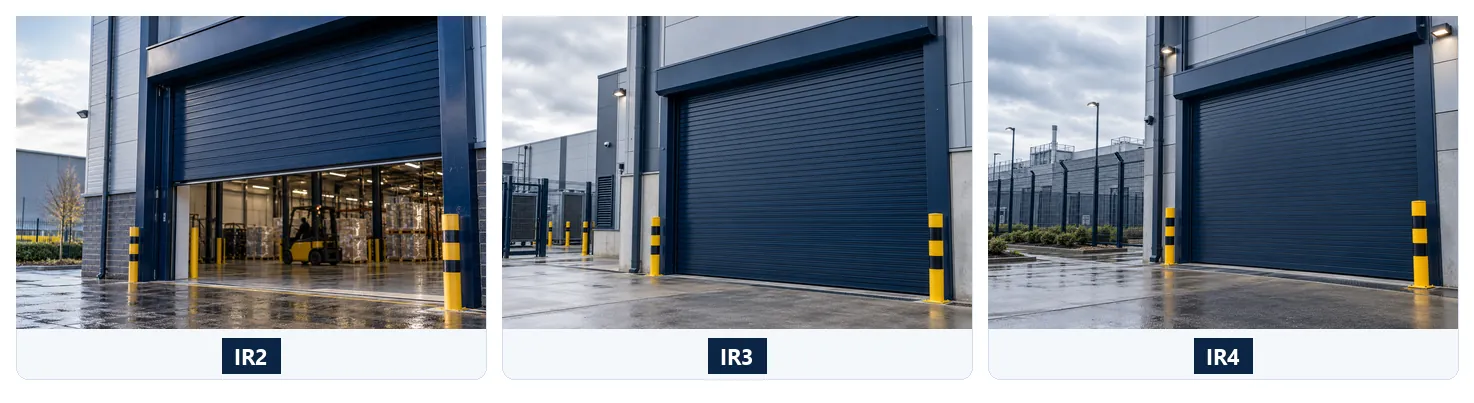
The certified range has three levels: IR2, IR3 and IR4. They run from lower-risk commercial buildings, warehouses and production facilities up to high-risk government, critical infrastructure and laboratory sites. Quote the level when you send the quote form. The photographs are illustrations of the type of door; the curtain, finish, opening size, speed and controls are confirmed in the specification, and the certificate must match the level and size you order.
| Model | Type | What it is |
|---|---|---|
| IR2 | Certified roller door | The entry level of the range, for lower-risk commercial buildings, warehouses and production facilities. |
| IR3 | Certified roller door | The middle level, for medium-risk commercial and utility buildings. |
| IR4 | Certified roller door | The highest level, for high-risk sites such as government, critical infrastructure and laboratories. |
Get a free quote
Related
More in security doors, windows and entrance control
Ready to specify your project?
Free assessment, written specification and test evidence. Reply within one working day.