
Security · LPS 1175 SR2 to SR5
Unbreakable mirrors
Unbreakable mirrors for UK custody suites, mental health units and prisons: steel and polymer builds, anti-ligature fixing and the evidence to ask for.
- ✓Third-party test evidence with every product
- ✓Written specification you can issue to tender
- ✓Supplied and installed across the UK
Get a free project quote
Rating, written specification and budget range within one working day.
Confidential. No cost, no obligation.
Third-party tested
Evidence with every quote
UK manufactured
Made to your sizes
One accountable team
Specify, supply, install
Confidential handling
Details never shared
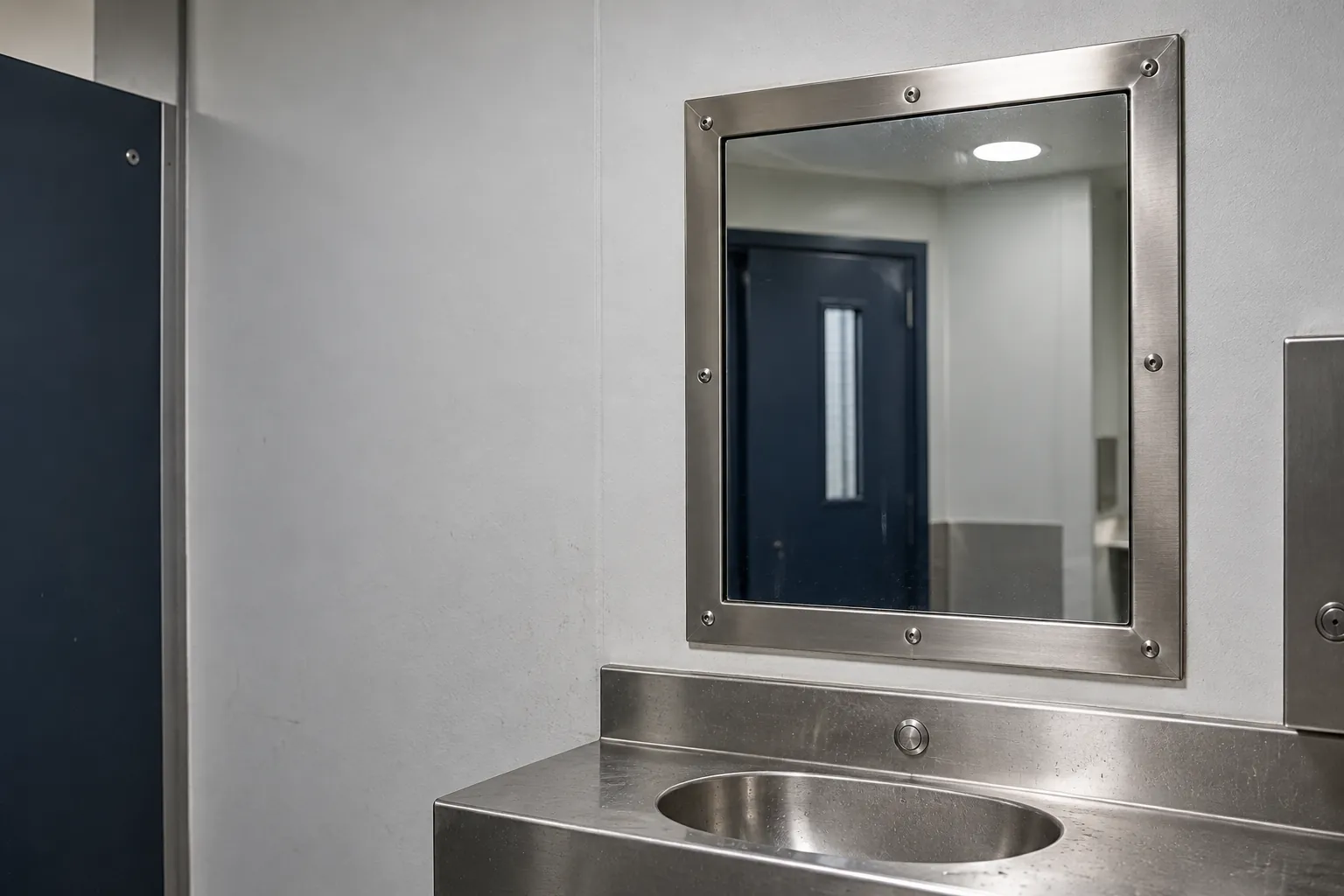
An unbreakable mirror replaces glass with polished stainless steel or a polymer mirror sheet bonded to a rigid back, so it cannot shatter into shards. In custody suites, mental health units and prisons the mirror must also resist ligature attachment, which comes down to the frame, the fixings and the edge detail.
- Zero glassPolished stainless steel or a polymer sheet, nothing that shatters
- Two risksBroken shards and ligature attachment points
- Fixings decideConcealed or tamper proof fixings with minimal edge gaps
- Evidence firstAsk for impact and durability test evidence in writing
Why an ordinary mirror is a hazard in secure settings
A glass mirror fails in two ways that matter in secure settings. First, it breaks into shards with sharp edges, and those shards become weapons or a means of self harm. Second, the mirror, its frame and its fixings create attachment points for a ligature.
The risk is not theoretical. In custody suites people arrive in crisis. In mental health units the whole environment is designed to remove means of self harm. In prisons any fixture that can be broken or removed becomes a problem for staff and other prisoners. A mirror is used every day, often alone, so it has to be designed for the setting rather than adapted from a domestic product. It sits within our wider security range
This is why the specification starts from the failure modes, not the reflection. Ask what happens when the face is struck, when someone tries to pull it off the wall, and where a cord could be looped.
Where unbreakable mirrors are specified
The core settings are custody suites, mental health inpatient units, prisons and police stations. In each, the mirror sits in cells, washrooms, corridors or communal areas where supervision is intermittent. Healthcare estates use them in seclusion rooms, bathrooms and corridors, where the detailing has to match the rest of the anti-ligature environment.
Government and defence estates specify them in detention and processing areas, and in any room where a standard mirror would create a maintenance or safety burden. Schools, leisure centres and transport interchanges use them too, but the detailing is usually lighter there because the threat is vandalism rather than deliberate self harm.
One common mistake is to treat every setting the same. A school washroom needs impact resistance. A mental health bedroom needs impact resistance plus ligature resistant detailing plus careful placement away from other anchor points. Write the specification from the setting before quotes are requested.
Stainless steel or polymer: the two constructions
There are two mainstream ways to make a mirror without glass. The first is polished stainless steel sheet, formed and finished to a mirror polish. The second is a polymer mirror sheet, usually polycarbonate or acrylic, bonded to a rigid backing board. Both remove the shatter risk. They differ in reflection quality, scratch behaviour and maintenance.
Stainless steel gives a slightly softer reflection than glass and it will show polishing marks over time, but it is hard to damage structurally and it suits wet areas. Polymer sheet gives a sharper reflection, closer to glass, but the surface can scratch, so cleaning discipline matters. Some polymer sheets carry a hard abrasion resistant coating. Ask how its durability was tested.
| Feature | Stainless steel | Polymer mirror sheet |
|---|---|---|
| Reflective face | Polished steel sheet | Mirror coated polymer on a rigid back |
| Reflection quality | Slightly soft | Sharp, close to glass when new |
| Impact behaviour | Dents rather than breaks | Flexes and resists shattering, can deform under sustained attack |
| Scratch behaviour | Shows polishing marks, can be refinished | Scratches unless hard coated, damaged sheets are replaced |
| Wet areas | Suits washrooms with the right grade and finish | Needs sealed edges and moisture resistant adhesive |
| Fixing options | Mechanical fixings or adhesive to a flat substrate | Bonded, mechanically fixed, or both combined |
Neither option is fit and forget. Stainless steel in a humid washroom needs the right grade and finish or it will stain. Polymer in direct sunlight needs UV stability or it will yellow and craze. State the environment on the enquiry so the supplier can confirm suitability in writing.
Fixing, frames and ligature resistant detailing
The face is half the product. The other half is how it is held to the wall. Ligature resistant detailing means removing anything a cord can loop around or grip: exposed screw heads, open edge gaps, protruding frames, hooks and brackets. The mirror should sit tight to the wall with minimal protrusion, and any frame should be closed and tamper proof.
There are two fixing approaches. Bonding the mirror to a flat, sound substrate hides every fixing, which is the cleanest ligature resistant detail, but it depends entirely on surface preparation and the right adhesive. Mechanical fixing with tamper proof fasteners is more forgiving of the substrate and allows removal for maintenance, but every fastener must be tamper proof and the heads must sit flush or be covered. In the most demanding settings both are used together, bonded and mechanically fixed, so one method backs up the other.
Corners and edges need the same attention. Radius corners remove sharp points and reduce the edge as a grip. Keep edge gaps minimal, and use a sealant that resists picking and stays bonded.
Specifier note. Write the fixing method into the specification, not just the mirror. Name the substrate, the adhesive or fastener type, the frame detail and the maximum permitted protrusion, and require the installer to confirm each one.
Mirrors are usually specified alongside security doors for the same rooms, so coordinate the ironmongery and frame finishes. Where the doorset also carries a fire rating, the detailing must satisfy both requirements; see fire and security doors. Our installation service, done by our own team or by our installation partners, covers the substrate preparation and fixing that the warranty depends on.
Cleaning and maintenance
The wrong cleaning routine ruins both constructions. Abrasive pads and scouring powders score polymer faces and dull stainless steel. Harsh solvents attack some polymer coatings and the adhesives behind the sheet. Specify the cleaning method at the same time as the mirror: soft cloth, mild detergent, no abrasives, and a named stainless steel cleaner if the finish needs one.
Plan for inspection. Fixings loosen, sealant perimeters crack, bonded edges lift. A regular visual check of every mirror in a secure setting takes minutes and catches the failures that recreate ligature points. Build it into the maintenance schedule rather than leaving it to chance.
Plan for replacement. When a polymer face is scratched beyond use, the sheet is replaced, which is straightforward if the fixing method allows removal. Record the construction and fixing method for every room so replacements match.
What evidence to ask for before you order
Ask for test evidence that matches the risks you are buying against. For impact resistance, ask how the face was tested, what it was struck with, and what the result was: did it shatter, crack, dent or deform, and were any fragments released? For ligature resistance, ask for a description of the tested assembly, fixings included, not just the face on its own.
Ask for the evidence in writing and keep it with the specification. A data sheet that describes the construction is not test evidence. What you want is a test report from an independent laboratory, or a clear statement of method and result that you can file. If the supplier cannot describe how the product was tested, treat that as information in itself.
Where the mirror sits in a room with other rated products, coordinate the specifications. Security glazing and mirrors are often ordered together for the same washroom or cell; our Hammerglass security glazing page covers the glazing side. The guide to specifying security doors is a useful template for the discipline of writing evidence requirements into an enquiry.
Finally, confirm the whole assembly: face, frame, fixings, substrate preparation and installer competence. A mirror is a system, and any test report should describe the system that was tested, not an idealised version of it.
Are unbreakable mirrors actually unbreakable?
No mirror is indestructible. Unbreakable means the reflective face does not shatter into sharp shards the way glass does. Stainless steel dents under heavy blows, and polymer sheets can scratch, deform or delaminate under sustained attack. Ask the supplier what happens at the limit of the product, and see it in a test report.
What is the difference between impact resistant and anti-ligature?
Impact resistant describes the face: it does not shatter. Anti-ligature describes the whole installation: the frame, the fixings, the edges and how far the mirror stands off the wall. A tough face on exposed screw fixings with an open edge gap is impact resistant but not anti-ligature. Specify both, and put the fixing method in writing.
Can they be used in showers and wet rooms?
Stainless steel suits wet areas when the grade and finish are right for constant moisture. Polymer sheets need sealed edges, a protected backing and an adhesive that suits wet conditions. State the wet environment on the enquiry and get suitability confirmed in writing rather than assuming it.
How do you clean a polymer mirror without scratching it?
Use a soft cloth and mild detergent, never abrasive pads or scouring powders, and avoid harsh solvents that can attack the coating or the adhesive. Train cleaning staff on the method and put it in the maintenance schedule, because one wrong clean can permanently mark the face.
Should the mirror be bonded, screwed, or both?
Bonding hides every fixing and gives the cleanest anti-ligature detail, but it needs a flat, sound, well prepared substrate. Tamper proof mechanical fixings tolerate poorer substrates and allow removal for replacement. In the most demanding settings both are used together so each backs up the other. Match the method to the substrate and the risk, and write it into the specification.
Get a free quote
Related
More in security doors, windows and entrance control
Ready to specify your project?
Free assessment, written specification and test evidence. Reply within one working day.