
Services
Powder coating guide
Powder coating guide for steel doors and metalwork in the UK: process stages, preparation, RAL and BS colours, gloss levels, defects and specification wording.
- ✓Third-party test evidence with every product
- ✓Written specification you can issue to tender
- ✓Supplied and installed across the UK
Get a free project quote
Rating, written specification and budget range within one working day.
Confidential. No cost, no obligation.
Third-party tested
Evidence with every quote
UK manufactured
Made to your sizes
One accountable team
Specify, supply, install
Confidential handling
Details never shared
Powder coating is a dry finishing process for metalwork. Electrically charged powder is sprayed onto the metal, then heat cured into a hard, even film. This guide explains the preparation, coating and curing stages, how to choose colours and gloss levels, and what to write in a specification for steel doors and architectural metalwork in the UK.
- Dry powder, heat curedElectrostatic spray, then an oven cure
- 60 to 120 micronsTypical dry film thickness
- RAL and BS coloursFrom matt to full gloss
- Preparation decides adhesionDegrease, blast, then prime
How the powder coating process works
Powder coating runs as a fixed sequence, and a weak stage early on shows up as a failure later. The stages are cleaning, profiling, pretreatment, spraying and curing, with inspection only after the part cools.
- Degrease and clean. Oil, cutting fluid and handling marks are removed so the coating bonds to metal, not grease.
- Shot blast. Steel is blasted to remove mill scale and rust, leaving a roughened profile the coating grips. This stage decides how long the finish lasts outside.
- Pretreat and prime. Galvanised steel and aluminium get an etch primer or conversion coating; exterior steel usually gets a zinc rich primer under the topcoat.
- Electrostatic spray. A gun charges the powder particles and the earthed part pulls them onto every surface, edges and recesses included.
- Cure and inspect. The part is heated, typically 180 to 200 degrees C for 10 to 20 minutes at metal temperature, until the powder melts, flows and cross links into one film.
Most powders used on steelwork are thermosetting. Heat starts a chemical reaction that hardens the film permanently, so a cured coating cannot be melted off and reworked. For plain steel the sequence starts with shot blasting; on a fabricated doorset the coating is usually the last step before hardware is fitted, as part of manufacture.
Preparation is most of the work. A coating fails at the surface it sits on. If blasting or pretreatment is skipped, no topcoat chemistry will make up for it, and the first sign is usually peeling at edges and welds.
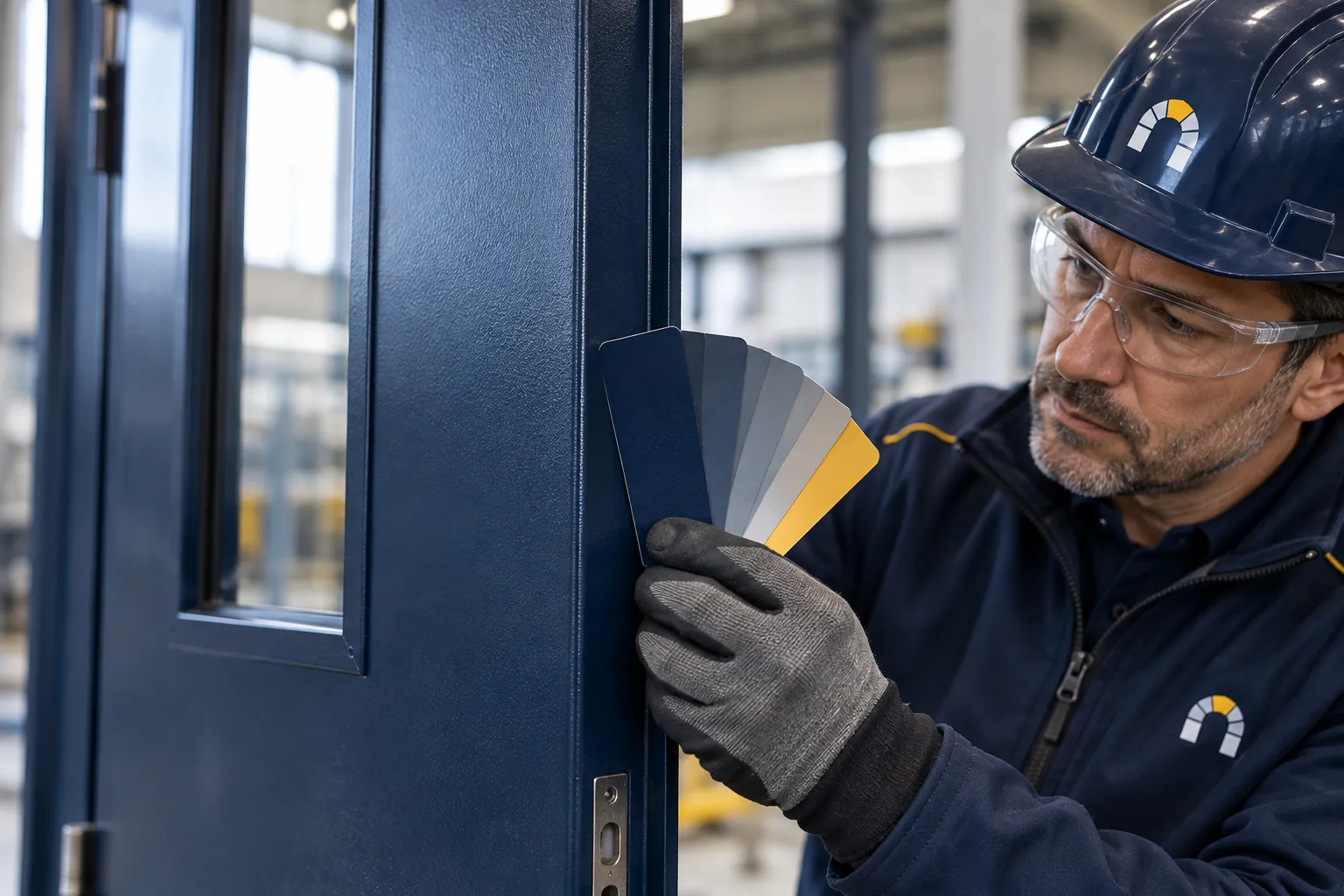
Choosing colours, gloss levels and textures
Powder is made in a wide colour range, and buyers in the UK usually specify from one of two systems. RAL Classic is the common standard for steelwork and architectural metalwork, with references such as RAL 7016 anthracite grey. BS ranges, including BS 4800 and BS 381C, still cover public sector and infrastructure work. Custom colours can be matched, but allow for slight variation between batches and order enough powder from one batch for the whole job.
Gloss is chosen separately from colour. The same RAL reference comes in different sheens, which changes both appearance and how the surface shows marks.
| Finish | Appearance | Suits |
|---|---|---|
| Full matt | Flat, no shine | Modern facades, interiors where glare is unwanted |
| Satin | Soft sheen | Doors and frames in commercial buildings |
| Semi-gloss | Noticeable shine | Retail fronts and high traffic entrances |
| Full gloss | Mirror-like shine | Feature metalwork, signage |
| Textured | Fine grain that hides marks | Plant rooms, shutters, heavily handled parts |
Matt and textured finishes hide fingerprints and small marks better than gloss, which is why satin and matt dominate on security doors in offices and schools. Gloss shows every ripple in the steel, so it needs flatter, better prepared metal underneath. Whatever the finish, put the exact RAL or BS reference and gloss level in writing. Colour names alone are not a specification.
Why powder coating beats wet paint on steel
On steel doors and frames, powder coating has real advantages over liquid paint. The film is harder and more chip resistant once cured, one coat does the work of several paint coats, and there are no solvents, so no solvent smell or runs, very low volatile emissions, and overspray that can be collected and reused. Coverage on edges and complex shapes beats brushed or sprayed liquid, provided the gun settings suit the part.
The cured film is thicker than paint, typically 60 to 120 microns, so threads, hinges, lock keeps and sliding parts need masking or a design allowance. Site touch ups never match the factory finish, so keep spare colour or accept a visible repair. Colour can drift slightly between powder batches, and heat sensitive parts, seals and gaskets cannot go through the oven, so they are fitted after coating. Where a door needs a powder coated finish and a fire rating in one assembly, confirm the coating suits the tested construction before the doors are made.
Coating defects and how to avoid them
Most defects trace back to dirty metal, wrong gun or oven settings, or badly stored powder. Knowing what each looks like helps you describe it when you reject a part.
| Defect | What you see | Usual cause | How it is avoided |
|---|---|---|---|
| Orange peel | Bumpy texture like citrus skin | Powder applied too thick or cured too cool | Correct gun settings and full cure schedule |
| Pinholes | Tiny holes through the film | Gas escaping from the metal or contamination | Proper degreasing and preheating porous parts |
| Craters | Small round dips, like fisheyes | Oil or silicone contamination | Clean handling and separate blasting media |
| Poor adhesion | Coating peels or flakes off | Skipped or weak preparation | Full blast and pretreatment sequence |
| Thin edges | Metal showing through on corners | Powder pulled away from sharp edges | Edge radiusing and a second pass on edges |
Adhesion is checked with a cross hatch test, a grid cut through the film with tape pulled off to see what lifts, and thickness with a dry film thickness gauge. Ask what checks the supplier runs as standard across their services. A supplier who measures and records both is taking the finish seriously; one who relies on a visual look alone is not.
What to write in your specification
A good specification is short and leaves nothing to guess. Name the substrate, the preparation, the powder system, the colour and gloss, the thickness and the inspection.
Start with the metal and its condition: new steel, galvanised steel or aluminium, and whether welds are ground flush. Then state the preparation in plain terms: degrease, shot blast to a clean bright finish, then the primer system. For exterior work, ask for a zinc rich primer under a polyester topcoat, because polyester powders resist ultraviolet light far better than epoxy powders, which chalk outdoors. State the dry film thickness as a range, typically 60 to 120 microns, and the exact colour reference with the gloss level, for example RAL 7016 matt.
Add the practical points that are often forgotten. List what must be masked: threads, hinge pockets, lock keeps, seals and any earthing points. State that the coating must be free of the defects in the table above, and name the acceptance tests: a cross hatch adhesion test and dry film thickness readings. For a security door, state that the coating must not change the tested construction and hardware positions must be masked, not coated.
Looking after a powder coated finish
Powder coating is low maintenance, not no maintenance. Wash exterior metalwork with water and a mild detergent, rinsing off road salt and grime before they sit on the film. Avoid abrasive pads, wire brushes and strong solvents, which dull or cut the surface. On retail fronts and education buildings, where doors take daily contact, check high touch areas for chips and treat them early.
Clean and touch up chips that reach bare steel promptly, because corrosion spreads under the film once it starts. Keep a small quantity of matching touch up paint from the same colour reference for this. Check moving parts too: hinges, locks and closers wear through any coating where metal rubs, so a maintenance visit should cover function as well as finish. When new doors are fitted, installation teams should protect coated surfaces and leave masking on until surrounding work is done.
Can you powder coat over old paint or an existing coating?
Only after proper preparation. Loose, flaking or chalking paint must be stripped back, usually by blasting, because the new coating is only as sound as what sits beneath it. A firmly bonded coating can sometimes be abraded and overcoated, but the supplier should confirm after seeing the part.
How thick should powder coating be?
For steel doors and architectural metalwork the dry film is typically 60 to 120 microns. Too thin risks poor coverage; much thicker risks orange peel and cracking on edges. The thickness should be stated in the specification and checked with a dry film thickness gauge.
Will powder coating work on galvanised steel?
Yes, with the right pretreatment. Galvanised surfaces need degreasing and an etch primer or sweep blast, and any white rust must be removed first. Freshly galvanised steel can also release gas during curing, which causes pinholes, so tell the supplier the steel is galvanised before work starts.
Can any colour be matched?
RAL and BS ranges cover most needs and are the safest way to specify, because both sides can check the same reference. Custom colours can be matched from a sample, but expect slight variation between batches, so order all powder for one job from a single batch.
How long does powder coating last outside?
There is no fixed figure. Life depends on the preparation, the powder system, the colour and the exposure. A well prepared system on a sheltered inland building lasts far longer than one on an unsheltered coastal site. Ask what test evidence the supplier holds for exterior work rather than accepting a bare promise of years.
Get a free quote
Related
More in services
Products
One supplier for the whole building envelope
Ready to specify your project?
Free assessment, written specification and test evidence. Reply within one working day.