

Perimeter and HVM · PAS 68 and IWA 14-1
Security bollards
Impact tested security bollards to ISO 22343-1:2023: fixed, removable, retractable and shallow mount options for UK streets, squares and sites.
- ✓Third-party test evidence with every product
- ✓Written specification you can issue to tender
- ✓Supplied and installed across the UK
Get a free project quote
Rating, written specification and budget range within one working day.
Confidential. No cost, no obligation.
Third-party tested
Evidence with every quote
UK manufactured
Made to your sizes
One accountable team
Specify, supply, install
Confidential handling
Details never shared
Security bollards are short, impact tested posts that stop vehicles from reaching footways, forecourts and building lines. They come as fixed, removable, retractable and shallow mount types. This page helps specifiers choose the right bollard for each part of a site.
- PAS 68 and IWA 14-1Impact test standards for bollards
- Fixed and removableTypes for every access need
- Shallow mount optionsFor streets with buried services
- Tested as a rowRating covers spacing and foundations
What is a security bollard
A security bollard is a short vertical post set into the ground to define where vehicles may not go. Impact tested versions are proven to stop a defined vehicle at a defined speed, and they form the most common element of a perimeter and HVM scheme. Rows of bollards guard footways, forecourts, building lines and the approaches to entrances.
Four types cover most sites. Fixed bollards are permanent and suit pedestrian zones. Removable, or lift-out, bollards allow occasional vehicle access for events or maintenance. Retractable bollards rise and fall for frequent controlled access. Shallow mount bollards need minimal excavation and suit streets where buried services rule out deep foundations. The vehicle impact ratings guide explains how each type is tested.
Choosing the right rating for security bollards
Choose the bollard type from how the space is used, then match the impact rating to the threat vehicle and speed. Every type below is rated as a tested system: product, spacing and foundation together.
| Bollard type | How it is used | What the rating must cover |
|---|---|---|
| Fixed | Permanent pedestrian zones and building lines | Tested as a row, with its foundation detail |
| Removable | Occasional vehicle access and events | Tested with its socket and locking arrangement |
| Retractable | Frequent controlled access | Tested with its housing and mechanism |
| Shallow mount | Streets with buried services | Tested at the reduced excavation depth |
Fixed, shallow mount, removable and automatic bollards suit different sites. Our guide to how to choose HVM bollards covers foundations, spacing and the weakest link in a line.
How security bollards are built
A security bollard is a steel core set into a concrete foundation or a tested socket. The foundation takes the impact load into the ground, which is why the rating always includes it. Spacing between units is set so a vehicle cannot pass between them, and the tested spacing must be kept on site.
Finishes are chosen for the setting: powder coating to a site palette is common, and visibility markings help drivers and pedestrians read the line at night. Removable and retractable types add sockets, locks or mechanisms that need periodic checks by the estates team.
Spacing is part of the rating. Bollards are tested as a row at a set spacing. Widening the gaps on site to suit paving joints can void the protection. Keep the tested spacing.
Combining bollards with other ratings
Bollards rarely stand alone. At vehicle entrances they pair with security gates, and at building entrances with security doors rated to LPS 1175.
Where security bollards are used
Public spaces use bollard rows to separate crowds from traffic on squares and promenades. High-value retail protects frontages and cash-handling entrances. Government and defence sites guard building lines and car parks, and transport hubs protect forecourts and drop-off zones.
What affects the cost and lead time of security bollards
The number of units and the length of the protected line set the base scope. Foundation type matters: deep foundations need excavation and concrete work, while shallow mount details reduce dig depth but need careful setting out. Ground conditions and buried services can change both cost and programme. Removable and retractable types add sockets and mechanisms, and bespoke finishes add time. Access for plant during installation also affects the programme on constrained city sites. No prices are given here because every site differs.
Choose by function first
| Function | Typical bollard | Ask for |
|---|---|---|
| Vehicle security | Crash rated steel, fixed, removable or automatic | PAS 68, IWA 14-1 or ISO 22343-1 rating and foundation detail |
| Guidance and demarcation | Non-rated steel, concrete or cast | Finish and spacing only |
| Appearance | Decorative sleeves over a rated core | Finish, colour and a rating for the whole assembly |
Reading a bollard rating
A PAS 68 rating is a short string, for example V/7500[N2]/64/90. Read it left to right: V for a vehicle impact test, 7500 for the vehicle mass in kg, [N2] for the vehicle category (a medium truck), 64 for the impact speed in km/h and 90 for the angle in degrees. The distance the vehicle penetrated past the barrier, and how far debris travelled, are recorded after a colon.
IWA 14-1 and ISO 22343-1 use the same logic internationally, and ASTM F2656 is the common US standard. The vehicle impact ratings page sets out the three systems.
What happens in a crash test
A test vehicle of a set mass is driven into the barrier at a set speed and angle. The test records how far the vehicle or its parts get past the barrier and how far debris is thrown. A barrier that stops the vehicle with little penetration earns a better rating, and the rating applies only to the tested foundation and installation.
Beyond the rating, guidance controls spacing, height and visibility. Our guide to bollard regulations in the UK sets out which rules apply and where they come from.
Materials and finishes
| Material | Strength | Watch for |
|---|---|---|
| Steel | High crash performance in a slim section, many finishes | Corrosion protection and sleeve options |
| Concrete | Heavy and economical for planters and blocks | Bulk, appearance and foundation depth |
| Cast or decorative | Heritage and public-realm appearance | Often guidance only unless tested |
| Timber or plastic | Guidance and demarcation | Not for vehicle security |
Selection checklist
- Threat. Which vehicle, how fast and how much run-up.
- Site. Services under the ground and the foundation depth available.
- Operations. Deliveries and emergency access decide fixed, removable or automatic.
- Gaps. Pedestrian and wheelchair spacing, because a gap is the weak link in a line.
- Guidance. PAS 69 is the companion guidance on selecting, installing and using barriers.
The HVM bollard guide compares fixed, shallow-mount, removable and automatic types.
Range and models
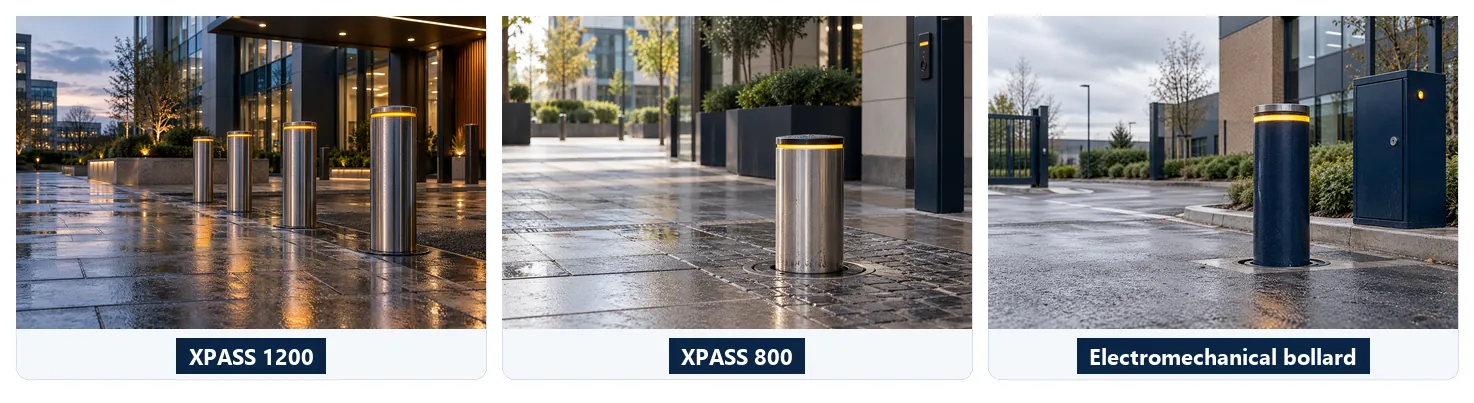
The automatic bollard range covers hydraulic and electromechanical operation. Quote the model name when you send the quote form. The photographs are illustrations of the type of unit; final size, glazing, finish, hardware and control system are confirmed in the specification. The crash rating applies to the tested bollard, its foundation and its installation, and the certificate is supplied with the quote.
| Model | Type | What it is |
|---|---|---|
| XPASS 1200 | Automatic crash-rated bollard | 1200 mm high and 330 mm in diameter, stainless steel with an LED light crown. Each bollard has its own pump, so the others keep working if the control unit fails. An emergency fast operation option raises the bollard rapidly. |
| XPASS 800 | Automatic crash-rated bollard | A lower bollard from the same family, tested as a single bollard, for sites where a shorter profile suits the street. |
| Electromechanical bollards | Automatic bollard | Automatic rising bollards with electromechanical operation, for controlled vehicle entry points. |
How to specify security bollards
- Define the threat. Name the vehicle mass and speed for the approach.
- Choose the type. Fixed, removable, retractable or shallow mount, matched to access needs.
- Confirm the tested detail. Keep the tested foundation, socket and spacing.
- Survey services. Check buried services and levels before fixing the line.
- Set the finish. Choose colour and markings to suit the setting.
- Verify the test record. Ask for third-party evidence naming the standard and rating.
A vehicle impact rating states vehicle, speed, angle and penetration. PAS 68 vs IWA 14 vs ISO 22343 explained decodes the format.
Security bollard FAQs
Can a removable bollard be PAS 68 rated?
Yes, if it was tested with its socket. The socket, the locking arrangement and the foundation are part of the rating, so a removable unit is only as good as the socket it sits in.
What gap should be left between bollards?
The gap from the tested row. Bollards are proven at a set spacing, and widening the gaps on site can let a vehicle through. Keep the tested spacing and build to the tested detail.
Do bollards need planning permission?
It depends on the location and the local authority. Bollards on the public highway usually need agreement with the highways authority, while those on private land are often permitted. Check early with the relevant authority.
How is emergency access kept?
Removable or retractable bollards are used on emergency routes, with keys or controls held by the estates team and the emergency services as agreed. Fixed rows must never block a required fire appliance route.
What happens after a bollard is struck?
The unit and its foundation are inspected before the line is put back into service. A struck bollard is normally replaced, and the socket or foundation is checked for damage that could weaken the next impact.
What is PAS 69?
PAS 69 is guidance on selecting, installing and using hostile vehicle mitigation. PAS 68 tests the barrier, while PAS 69 helps you choose and place it.
What should an automatic bollard do if the power fails?
Ask the supplier. Typical options are hand operation or a defined fail-secure position, and the answer should be written into the specification.
Get a free quote
Related
More in perimeter security and hvm
Where we supply security bollards
Pick your area to see how we specify and supply security bollards for the buildings there.
Ready to specify your project?
Free assessment, written specification and test evidence. Reply within one working day.