
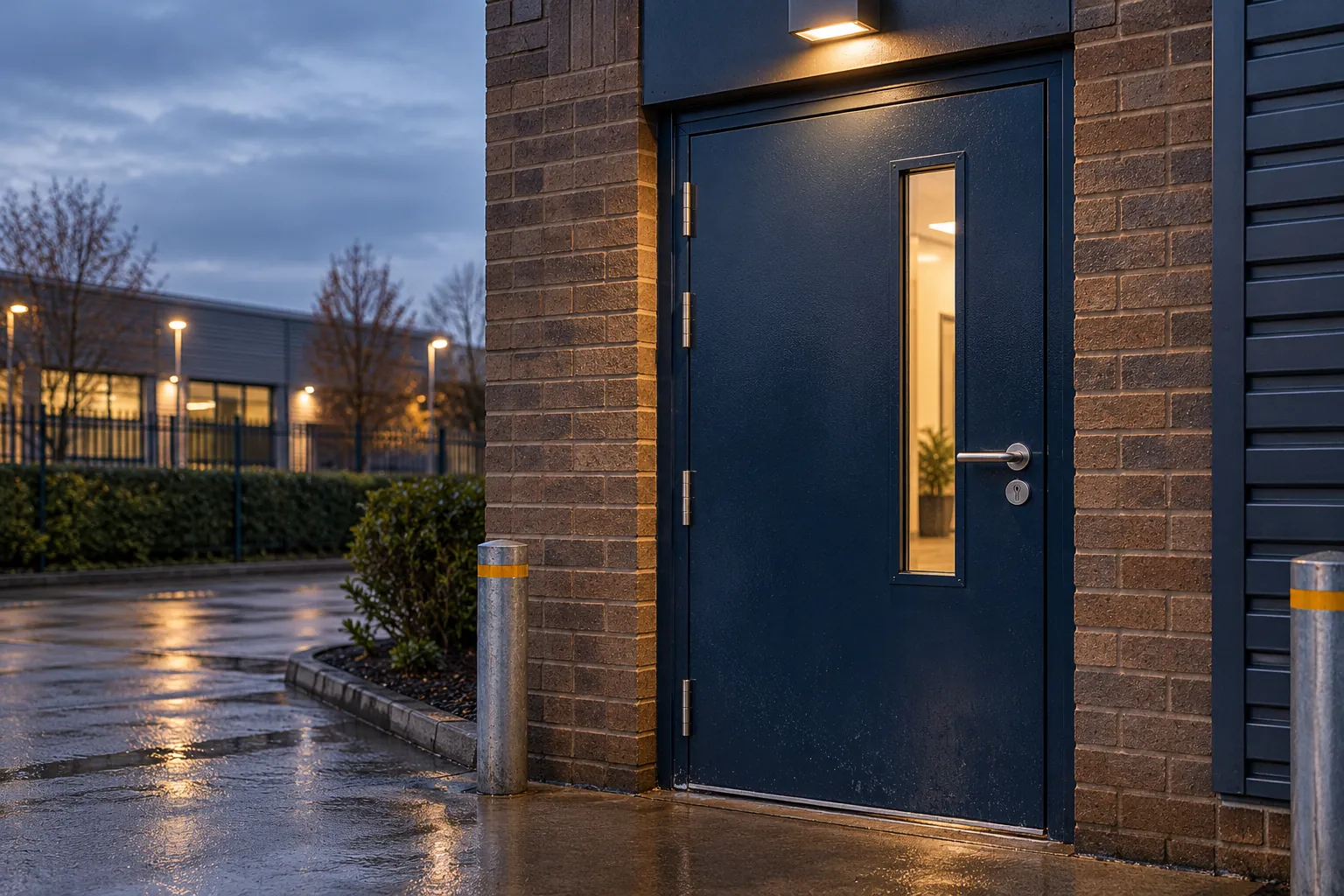
Security · LPS 1175 SR2 to SR5
LPS 2081 swing security doors
LPS 2081 swing security doors: SRA and SRB stealth ratings for UK specifiers, how they differ from LPS 1175 and where quiet attack resistance matters.
- ✓Third-party test evidence with every product
- ✓Written specification you can issue to tender
- ✓Supplied and installed across the UK
Get a free project quote
Rating, written specification and budget range within one working day.
Confidential. No cost, no obligation.
Third-party tested
Evidence with every quote
UK manufactured
Made to your sizes
One accountable team
Specify, supply, install
Confidential handling
Details never shared
LPS 2081 swing security doors are tested against stealth attack, where the intruder tries to force entry without making significant noise. Security Rating A covers a one minute attack with easily concealed tools; Security Rating B covers three minutes with tools of greater mechanical advantage. They suit occupied buildings where noise would raise the alarm.
- SRA: 1 minuteStealth attack with easily concealed hand tools
- SRB: 3 minutesStealth attack with tools of greater mechanical advantage
- LPCB testedFull doorset, leaf, frame, locks and glazing as one assembly
- Quiet threatFor occupied buildings where noise would alert people
What a stealth attack looks like
A stealth attack is a burglary technique built around silence. The intruder picks a moment when the building is occupied or overlooked, then works on the door with tools that draw no attention. There is no hammering, no drilling that echoes down a corridor, no shattered glass. The goal is to open the door, or to create a hole large enough to reach through, before anyone notices anything wrong. The LPS 2081 standard was written for exactly this threat.
Test laboratories simulate the attack with two tool kits. Security Rating A uses small hand tools that are easy to conceal about the person, the sort of kit an opportunist could carry without looking suspicious. Security Rating B uses tools with greater mechanical advantage, still fairly easy to conceal, applied for a longer attack. In both cases the testers work on the complete doorset: the leaf, the frame, the locks, the hinges and any glazing. A weak point anywhere in the assembly fails the rating.
The one and three minute figures are attack time, the period tools are actually applied, with rest periods around it. What matters is the comparison: SRB gives an intruder three times the working time of SRA, with a stronger tool kit.
SRA versus SRB: the two security ratings
LPS 2081 has only two ratings, and the choice between them is a judgement about the building. SRA suits doors where the main risk is casual interference or opportunist entry, and where staff or residents are close enough to notice a prolonged attack. It is the lower of the two grades, but it still demands a properly engineered doorset with tested locks and fixings.
SRB is the higher grade and the more commonly specified of the two for commercial work. The three minute attack with a stronger tool kit filters out doorsets that rely on a heavy leaf but a weak frame, or on glazing that gives way quietly. If the door protects a room with valuable equipment, controlled substances or sensitive records, SRB is usually the right call.
Match the rating to the consequence of entry, not just the likelihood of attack. A back door to an unvisited plant room justifies SRB more readily than a front door in view of a reception desk. Write the rating as “LPS 2081 Security Rating A” or “LPS 2081 Security Rating B” and ask for the certificate naming that exact rating.
Who specifies LPS 2081 doors
LPS 2081 doors are specified for buildings where people are present and a noisy attack would be heard. Schools and colleges use them on doors that are attacked out of hours but overlooked by neighbours, and on internal doors to rooms holding IT equipment. Hospitals and clinics specify them where wards stay occupied through the night and a forced entry with power tools would be noticed at once, but a quiet attack on a side door might not.
Apartment blocks and managed housing are another common case. Entrance and stairwell doors face repeated low level interference, and residents quickly report loud attacks but may sleep through a quiet one. Offices with evening cleaners, leisure centres with early morning staff and retail units on busy streets all share the same pattern: the building is never truly empty, so the realistic threat is the intruder who stays quiet.
LPS 2081 does not suit unoccupied sites. A remote substation or vacant unit faces a different threat, because the intruder has no reason to stay quiet. There the specifier should look at LPS 1175 ratings, which assume the attacker uses whatever tools work fastest, noise included. The starting question is always: would a noisy attack be noticed here?
LPS 2081 versus LPS 1175
The two standards come from the same stable, the Loss Prevention Certification Board, but they simulate different attackers. LPS 1175 grades forced entry by tool category and attack time, from A1 (old SR1) up through H20 (old SR8). Its test assumes the intruder does not care about noise. LPS 2081 grades only stealth, with two ratings, SRA and SRB. The table below sets out the practical differences.
| Point | LPS 2081 | LPS 1175 |
|---|---|---|
| Attack style | Stealth, minimal noise | Forced entry, noise allowed |
| Ratings | SRA 1 minute, SRB 3 minutes | A1 to H20, for example B3 3 minutes, C5 5 minutes, D10 10 minutes |
| Tool kits | Concealable hand tools, greater mechanical advantage at SRB | Category A opportunist tools up to category H extreme tools |
| Best for | Occupied buildings where noise alerts occupants | Any forced entry threat, graded by time and tools |
One rating does not imply the other. A doorset tested to LPS 1175 B3 has survived three minutes against category B tools, but the test did not restrict noise, so it says nothing about stealth. Equally, an SRB doorset has no rated resistance to a noisy attack with heavy tools. Where both threats are realistic, the specification should name both standards and the evidence must list each rating separately.
Noise is the dividing line. Pick the standard that matches the attacker the building is likely to face. If a loud attack would be heard and stopped, LPS 2081 is the honest specification; if the site is empty at night, LPS 1175 fits better.
Combining LPS 2081 with other ratings
Doorsets can carry more than one rating, and many specifications ask for it. A common combination is LPS 2081 for stealth with LPS 1175 at B3 or C5 for forced entry, so the door resists both the quiet opportunist and the determined attacker. Another is LPS 2081 alongside a fire rating to EN 1634-1, where the same doorset must hold back fire for 30 or 60 minutes and resist quiet attack; the fire and security doors range covers that dual requirement.
Higher threat sites combine stealth resistance with other disciplines. A door on a government building might need LPS 2081 plus bullet resistant doors rated to EN 1522, or plus blast resistant doors where the threat assessment calls for it. Each rating is tested separately, and the certificate for each must name the exact doorset, including leaf size, frame type, hardware and glazing. A rating earned on one configuration does not transfer to a different one.
Glazing deserves special attention in a combined specification. The LPS 2081 test attacks the glazing as part of the doorset, so the glass must be part of the tested assembly. LPS 1270 security glazing carries its own three digit rating for hand hole, arm hole and body passage resistance. Ask the supplier to confirm in writing that the quoted glazing matches the test evidence.
How to write the specification
Write the requirement as a performance clause, not a product description. Name the standard, the rating, and the evidence, and require the complete doorset as tested. A workable wording is: “Steel swing doorset tested and certified to LPS 2081 Security Rating B, supplied with third-party test evidence covering leaf, frame, locks, hinges and glazing as a single assembly.”
Then add the details that keep the rating valid after handover. Require installation by the supplier or to the supplier’s instructions, because a certified doorset fitted into a weak opening is no longer the tested assembly. Set a maintenance schedule that covers locks, closers and seals, and state that any change to hardware or glazing needs written approval. The guide to keeping an LPS 1175 rating valid explains the same principle, and it applies equally to LPS 2081: the rating belongs to the doorset as tested, and anything that changes the doorset can void it.
Ask for these documents before ordering: the LPCB certificate or listing naming the exact doorset and rating, the test report summary, and the schedule of hardware and glazing in the tested configuration. Compare the schedule line by line with the quotation. For the wider security doors range, including swing security doors and the related LPS 1175 swinging security doors, the same evidence discipline applies.
Is LPS 2081 better than LPS 1175?
Neither is better; they test different attacks. LPS 2081 tests stealth with quiet tools, while LPS 1175 tests forced entry regardless of noise. Choose the standard that matches the threat at the building, or specify both with separate evidence for each.
What is the difference between SRA and SRB?
SRA is the lower grade: a one minute stealth attack with easily concealed hand tools. SRB is the higher grade: a three minute stealth attack with tools of greater mechanical advantage. SRB suits doors where the consequence of entry is serious.
Does LPS 2081 cover the glazing in the door?
Yes. The test attacks the complete doorset, including any glazing, the frame, the locks and the fixings. The rating only applies to the exact glazed configuration that was tested, so check the test schedule names the glass.
Can one doorset hold LPS 2081 and LPS 1175 at the same time?
Yes. Many doorsets are tested to both standards. The evidence must list each rating separately, because passing one test says nothing about the other. Ask for certificates that name both ratings against the same doorset configuration.
Where is LPS 2081 most often specified?
Schools, hospitals, offices, apartment blocks and anywhere else that stays occupied or overlooked. The common factor is that a noisy attack would be noticed quickly, so the realistic threat is the intruder who works quietly.
Get a free quote
Related
More in security doors, windows and entrance control
Ready to specify your project?
Free assessment, written specification and test evidence. Reply within one working day.