
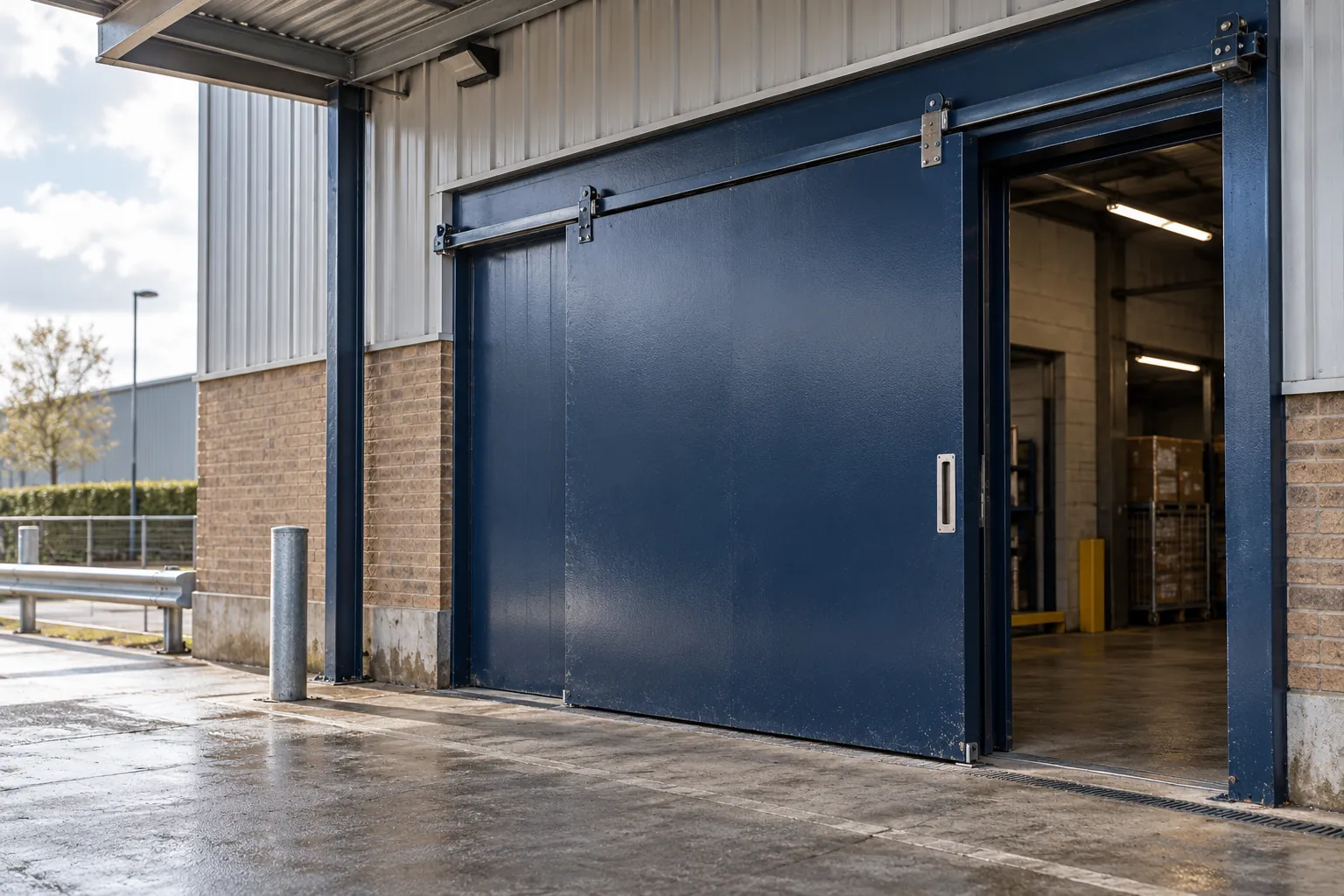
Security · LPS 1175 SR2 to SR5
Sliding security doors
Sliding security doors for UK specifiers: rated single and bi-parting leaves, track and locking design, LPS 1175 options and what keeps the rating valid.
- ✓Third-party test evidence with every product
- ✓Written specification you can issue to tender
- ✓Supplied and installed across the UK
Get a free project quote
Rating, written specification and budget range within one working day.
Confidential. No cost, no obligation.
Third-party tested
Evidence with every quote
UK manufactured
Made to your sizes
One accountable team
Specify, supply, install
Confidential handling
Details never shared
A sliding security door is a doorset whose leaf, track, guides and locking were tested together as one assembly, to a standard such as LPS 1175. Because the leaf never swings, sliding suits wide openings, plant rooms, retail fronts and goods in areas. The track and guide are the weak point, so the certificate must cover them.
- Tested as one assemblyLeaf, track, guides and locks certified together
- A1 to H20LPS 1175 ratings for sliding doorsets
- Single or bi-partingOne leaf or two meeting leaves
- Manual or poweredHand operation or automation with manual override
What a security rated sliding door is
A security rated sliding door is not a heavy leaf hung on a shop bought track. It is a complete doorset: the leaf, the frame, the track, the guides, the rollers and the locking, all tested together against forced entry. The rating applies only to the exact configuration that went through the test. Change one part and the rating no longer holds.
The difference from a swing door is the way the leaf moves. A swing leaf turns on hinges and presses into its frame seals. A sliding leaf runs on a track, in a plane parallel to the wall, and never needs a swing arc. That makes sliding the practical choice where a swing leaf would hit equipment, racking or people, and it moves the security problem from the hinges to the track.
Most sliding security doors are specified for commercial and industrial buildings. When you compare a slider with swing security doors, the security question is the same: which attack standard, which rating, and does the certificate describe the exact doorset you will receive.
Single leaf or bi-parting: choosing the layout
A single leaf slider has one moving leaf that runs to one side. It is the simpler build, with fewer meeting points and one locking edge, and it is usually the first choice up to the certified width of the design.
A bi-parting slider has two leaves that meet in the middle and part to either side. It covers wider openings without one very heavy leaf. The meeting point needs its own attention: the two leading stiles must interlock or overlap so the centre cannot be prised apart, and the certificate must show the bi-parting arrangement. A certificate for a single leaf does not cover a bi-parting pair.
Whatever the layout, the track length, leaf count and stacking arrangement must match the certified design.
The track and guide: where sliding doors fail
On a swing door the hinges take the attack. On a sliding door it is the track and the guide. The classic way to defeat a sliding door is to lift the leaf up and off its track, or to lever the bottom of the leaf out of its guide. A rated sliding doorset is designed around stopping exactly that.
Look for continuous top and bottom guides, anti lift devices that stop the leaf being raised clear of the track, and a shrouded or recessed track that keeps tools away from the rollers. Fixings matter as much as the track: the track must anchor into the structure around the opening.
The threshold needs the same care. A raised track across a doorway collects debris and becomes a trip hazard, so many designs recess the bottom guide flush with the floor. Debris in the track is not just a nuisance; a leaf that cannot close fully cannot lock, and a door that cannot lock has no rating in practice.
Certificate check. Ask for the certificate to name the sliding configuration: leaf count, track type, guide arrangement and locking. A swing door certificate, or one that only names the leaf, does not cover a sliding doorset.
Locking, bolting and manual override
A sliding leaf cannot use hinge side bolts, so the locking works differently. Rated sliding doors use multi point locking on the leading stile, with hooks or bolts that engage the jamb, the head track and often the floor. The lock must resist slipping, drilling and levering, and the keep plates must be part of the tested assembly.
On bi-parting pairs the meeting stiles lock to each other as well as to the frame. Shoot bolts at the top and bottom of the passive leaf are common, but they must engage keeps that were in the test. A bolt that drops into a site drilled hole in the floor is not the same as a bolt engaging a tested keep.
Powered sliders add one more requirement, a manual override. If the power fails or the controls are damaged, the door must still be openable from the escape side without tools or specialist knowledge. Test the override during commissioning, not during an emergency.
Manual or powered operation
Manual sliding doors suit openings used a few times a day: plant rooms, stores, back of house doors. A well balanced leaf on a clean track moves easily by hand, with no motor or controls to maintain. The limit is weight and frequency; a heavy leaf moved dozens of times a day wears its rollers and tempts users to leave it open.
Powered sliding doors suit frequent traffic: retail entrances, logistics, transport buildings. Size the operator for the leaf weight and duty cycle, and fit safety devices that stop or reverse the leaf if it meets a person. Power brings a failure question for the fire strategy: what does the door do when the power fails. An escape route needs the door openable on power loss, with the manual override reachable. A secure boundary may need it to stay locked. Write the required behaviour into the specification.
Ratings you can specify
Forced entry ratings for sliding doors come from LPS 1175, the LPCB forced entry standard. The rating is a tool category letter plus minutes of attack time, and it applies to the whole sliding assembly. The table below uses the Issue 8 labels.
| Rating | Old label | Attack time | Attacker and tools |
|---|---|---|---|
| A1 | SR1 | 1 minute | Opportunist with basic hand tools |
| B3 | SR2 | 3 minutes | Screwdrivers, pliers, hand saws |
| C5 | SR3 | 5 minutes | Crowbars, drills, chisels |
| D10 | SR4 | 10 minutes | Sledgehammers, disc cutters, jigsaws |
| E10 | SR5 | 10 minutes | Determined attacker, extended tool set |
| F10 | SR6 | 10 minutes | Determined attacker, extended tool set |
| G10 | SR7 | 10 minutes | Determined attacker, extended tool set |
| H20 | SR8 | 20 minutes | Extreme tools, category H |
Higher ratings are harder to achieve on sliding doors than on swing doors, because the track is difficult to protect at the top end of the tool scale. Match the rating to the threat and check that the certificate genuinely covers the sliding configuration at that rating. A slider can also carry a fire or blast rating, but each needs its own test on the sliding configuration. See fire ratings, fire and security doors and blast resistant doors.
Where sliding suits better than swing, and keeping the rating valid
Sliding wins wherever a swing arc gets in the way. Wide openings are the obvious case: a large swing leaf needs metres of clear floor, while a slider needs none. Plant rooms with equipment near the door, retail fronts where the leaf must not swing into the trading floor, goods in bays with forklift traffic, and transport hubs with crowd flow all favour sliding.
Sliding has limits worth stating. A sliding leaf brushes past its seals rather than pressing into them, so check weather, dust and acoustic needs separately if they matter. The track must stay clear, and the leaf needs wall space beside the opening to stack, which is not always available in a retrofit.
Keeping the rating valid is mostly about not changing the doorset and not neglecting it. Three rules from the keeping an LPS 1175 rating valid guide apply with extra force to sliders: never swap the track, guides, rollers or locks for untested parts; keep the track clear and the rollers adjusted so the leaf closes and locks fully; and treat maintenance as part of the security measure, checking anti lift devices, lock engagement and override function.
What voids a rating in practice: fitting a different operator or lock, site modifying the track or guides, fixing the track to a weaker substrate than the certificate requires, or adding automation that was not in the test. Any of these means the door is no longer the doorset that was tested. Installation by people who understand rated doorsets is the first defence against all of them, and the security doors range page sets out the wider options.
Can a sliding door achieve an LPS 1175 rating?
Yes. The whole sliding assembly, leaf, track, guides, rollers and locking, is attack tested to LPS 1175 and rated from A1 to H20. The certificate must name the sliding configuration.
What is the weak point of a sliding security door?
The track and guide. The standard attack is lifting the leaf off its track or levering the bottom out of the guide. Rated designs answer this with continuous guides, anti lift devices, shrouded tracks and structural fixings.
Can a powered sliding door be used on an escape route?
Only with a working manual override and in line with the building fire strategy. The door must be openable from the escape side without power, tools or specialist knowledge.
Is a sliding door as secure as a swing door at the same rating?
The rating means the same thing in both cases: the tested resistance to the stated tools for the stated time. Choose between them on the opening, not on an assumed security difference.
What voids the rating on a sliding security door?
Changing the track, guides, rollers, locks or fixings, adding automation that was not tested, or letting the door degrade so it no longer closes and locks.
How do I specify a sliding security door?
Name the standard and rating, the leaf arrangement, the track and guide type, the locking, and the manual override for powered doors. Ask for third party test evidence that matches every one of those items.
Get a free quote
Related
More in security doors, windows and entrance control
Ready to specify your project?
Free assessment, written specification and test evidence. Reply within one working day.