
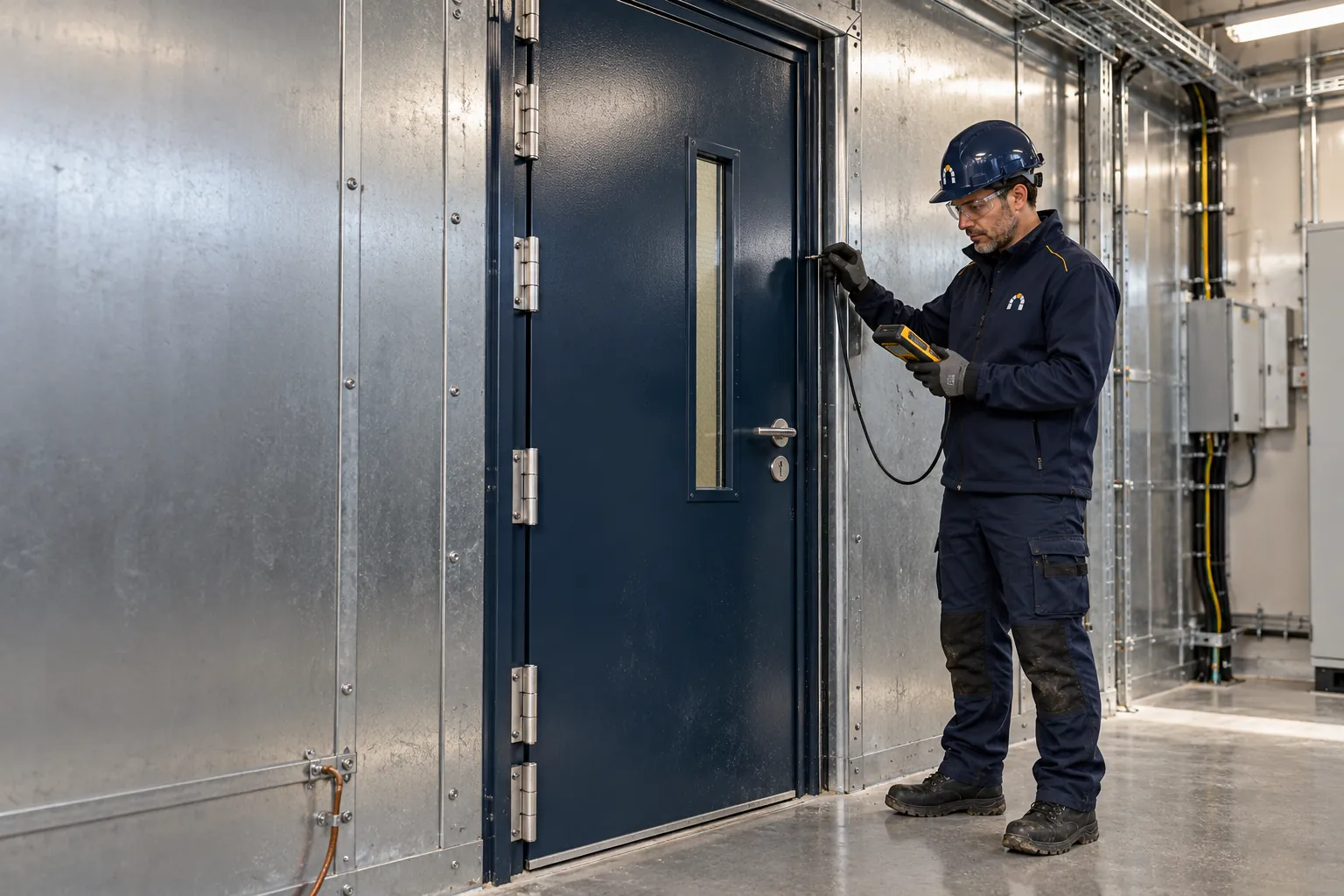
Shielding · EMP, RF and MRI
EMP shielding
EMP shielding for critical electronics: shielded rooms with filtered power and signal entries, designed and tested for UK data halls and control rooms.
- ✓Third-party test evidence with every product
- ✓Written specification you can issue to tender
- ✓Supplied and installed across the UK
Get a free project quote
Rating, written specification and budget range within one working day.
Confidential. No cost, no obligation.
Third-party tested
Evidence with every quote
UK manufactured
Made to your sizes
One accountable team
Specify, supply, install
Confidential handling
Details never shared
EMP shielding protects critical electronics from electromagnetic pulses. A shielded room with filtered power and signal entries keeps essential systems working through pulse events. This page is for consultants and estates teams responsible for critical infrastructure.
- EMP protectionShielding for critical electronics
- Filtered power entriesPower lines sealed against pulses
- Shielded doors and ventsEvery penetration treated
- Installed and testedPerformance verified on completion
What is EMP shielding
An electromagnetic pulse is a short, intense burst of electromagnetic energy that can damage or upset unprotected electronics. EMP shielding is the set of measures that keeps such a pulse away from critical equipment: a continuous shielded envelope around the room, with every power and signal entry filtered. It is one discipline within our shielding range, aimed at sites where equipment failure is not an option.
Protection is specified as attenuation: how much of the pulse the room blocks across the frequencies of concern. The design starts from the equipment to be protected and the level of assurance the site needs, agreed with the consultant before any construction begins.
Which EMP specification do you need
An EMP shielded room is a system, not a single product. The table below lists the elements every design must include; leave one out and the pulse will find it.
| Element | Purpose | Notes |
|---|---|---|
| Shielded envelope | Blocks the pulse | Walls, floor and ceiling as one conductive shell |
| Filtered power entries | Stops pulses entering on mains | Every power line filtered at entry |
| Filtered signal entries | Stops pulses entering on data lines | Every signal line filtered at entry |
| Shielded doors | Access without breaking the envelope | Conductive gaskets and seals |
| Ventilation waveguides | Air in, pulses out | Honeycomb vents that block signals |
RF shielding and magnetic shielding are different things. MRI and RF shielded rooms explained covers attenuation, penetration points and acceptance testing.
How EMP shielding works
The room is lined to form a continuous conductive envelope: walls, floor and ceiling joined with sealed seams so the pulse cannot pass through. All services enter at defined points, and every power and signal line passes through a filter that blocks the pulse while letting the normal supply through.
Doors use conductive gaskets so the envelope stays continuous when they close, and ventilation uses waveguide vents that pass air but not signals. The layout keeps cable runs short and avoids new penetrations after the room is commissioned.
Cable routing inside the room is kept short and tidy, with services entering at one defined point so the envelope has a single boundary to defend. Filters are mounted where they can be reached for inspection, and spare ways are capped rather than left open. The layout is documented so future changes do not punch unplanned holes in the shield.
One unfiltered cable defeats the room. A pulse will enter through the weakest path. Route every power and signal line through filters at a single entry point, with no exceptions.
Combining EMP shielding with other ratings
Sites that fear EMP often face other threats too. Where blast is also a concern, blast resistant doors protect the room’s entrances, and attack, blast and gas protection adds gas-tight sealing and blast valves. The building line around the facility can use security doors rated to LPS 1175 against forced entry. Our standards hub explains the rating systems behind these products.
Where EMP shielding is used
Utilities and energy sites protect control rooms and switching equipment. Government and defence estates shield communications and command facilities. Data centres use shielded rooms for equipment that must survive pulse events and keep services running.
What affects the cost and lead time of emp shielding
Room size sets the lining scope, and the number of penetrations sets the filter count: each power and signal entry needs its own filtered treatment. New build rooms are simpler than retrofits, where existing services must be rerouted or sealed. The target attenuation and the extent of testing and documentation also affect the programme. No prices are given here because every room differs.
Shielded room, safe speech room or TEMPEST room?
| Term | Protects against |
|---|---|
| Shielded (Faraday) room | Radio frequency signals passing in or out, rated by attenuation in dB over a frequency range |
| Safe speech room | Conversation being overheard, by acoustic insulation |
| TEMPEST room | Equipment emissions leaking out, often built on a shielded room |
Not all shielded rooms do all three. TEMPEST is a codename for emission security rather than an acronym, and a shielded room does not by itself make a safe speech room.
EMP protection and RF shielding overlap but are not the same need. Our guide comparing Faraday cages and RF shielded rooms explains the difference in plain terms.
Standards to name in a specification
- MIL-STD-188-125 covers high-altitude electromagnetic pulse protection for facilities.
- SDIP-27 and SDIP-29 are NATO documents on emission security and installation.
- IEEE 299 is the method for measuring shielding effectiveness.
The RF shielding page explains the attenuation terms.
From enclosure to whole facility
- Enclosure. A shielded cabinet or rack protects the highest value equipment.
- Room. A shielded room protects a defined area.
- Container. A deployable unit is faster to place.
- Facility. Whole-building protection needs a survey and design programme.
Put the highest value equipment in the strongest tier. Final scope follows survey, and the data centre guide shows how zones are layered.
Testing, grounding and re-verification
Acceptance testing measures attenuation in dB across the threat frequencies and checks every penetration, because doors, filters and cable entries are where rooms fail. Grounding is designed with a qualified electrician. Re-test after any modification, and at intervals for sensitive rooms. See testing and surveys.
How to specify EMP shielding
- List the equipment. Define what must keep working through a pulse event.
- Survey the room. Record construction, services and every penetration.
- Design the envelope. Fix the lining, entries, doors and ventilation.
- Install shielding and filters. Build the envelope and fit filtered entries.
- Treat every penetration. Seal doors, vents, pipes and cables.
- Check the shielding. Confirm attenuation with independent testing.
For how HVM, entrance control, glazing and shielding fit together across zones, see data centre physical security by zone.
What EMP shielding does not prove
Attenuation is measured in dB across a stated frequency range. A figure without the range behind it proves nothing, because a room can block one band and pass another. Ask for the frequencies the figure covers, and check they match the equipment the room protects.
The test is run on the room as built, with the doors closed and every entry filtered. It does not prove the room stays shielded when a door is held open, when a cable is added after handover, or when a gasket wears. The result belongs to the day it was measured and the arrangement that was measured.
Shielding blocks radio signals. It does not make the room a safe speech room, which depends on acoustic insulation, and it does not prove the room meets TEMPEST requirements, which concern emissions leaking out. Each need has its own evidence, and one test result never stands in for another. For the difference between the two needs, see Faraday cages and RF shielded rooms.
A shielded room does not prove the equipment inside will keep working. Power quality, cooling and the equipment itself sit outside the shielding test, so the room specification and the equipment specification must be checked separately, and a failure in either one can stop the room doing its job.
The room protects what is inside it. It does not protect cables that run outside the envelope, or equipment in the next room, so the boundary of the shield must be drawn on the drawings and agreed before work starts. A cable that crosses the boundary without a filter is a gap in the shield, wherever it runs.
Grounding is designed with a qualified electrician, and the design is part of the room, not an extra. A shield earthed to the wrong point can carry interference into the room it is meant to protect, so the grounding arrangement must be recorded with the test report.
Mistakes that weaken a shielded room
Most shielded rooms fail after handover, not during construction, because the room is changed after it was tested. The checks below catch the errors that appear most often.
- Specifying an attenuation figure with no frequency range behind it
- Adding a cable or pipe through the envelope after the room is commissioned
- Leaving a spare filter way open instead of capping it
- Fitting a door with gaskets that are never inspected or replaced
- Treating an RF shielded room as EMP protection without checking the threat frequencies
- Skipping the re-test after a modification, and relying on the original result
The room needs a named owner after handover. Filters, gaskets and vents all age, and a room with no inspection schedule will drift out of specification without anyone noticing. Put the inspection intervals and the re-test trigger in writing, with the room documents, so the next person to work on the room knows the rules.
Each of these is cheap to prevent at specification stage and costly to fix once the room is in use. A specification that names the frequencies, the entries and the re-test rule leaves nothing to interpret. For how attenuation is measured after installation, see testing and surveys.
EMP shielding FAQs
What is an EMP?
An electromagnetic pulse is a short, intense burst of electromagnetic energy. It can damage or upset unprotected electronics, which is why critical sites shield the rooms that house essential equipment.
Can EMP protection be retrofitted?
Yes, by lining an existing room to form the shielded envelope and fitting filtered entries. A survey of the construction and services comes first, because every existing cable and pipe is a potential leak.
Does an EMP shielded room block mobile signals?
A shielded room attenuates radio signals as a side effect of its construction, so mobile phones and Wi-Fi perform poorly inside. Plan communications for the room accordingly.
How is an EMP shielded room maintained?
Inspect door gaskets and seals on a schedule, and check the filters as part of the room’s maintenance regime. Any work that adds a cable or pierces the envelope calls for a re-test afterwards.
How is EMP shielding tested?
By measuring the room’s attenuation across the specified frequencies after installation. Our testing and surveys service issues a written report that forms part of the project file.
Is TEMPEST an acronym?
It is a codename for emission security programmes. You will see it expanded in places, but the term is simply used for protection against compromising emissions.
Does a shielded room also work as a safe speech room?
Not necessarily. Shielding blocks radio signals, while a safe speech room is about acoustic insulation. If you need both, specify both.
Get a free quote
Related
More in specialist shielding
Where we supply EMP shielding
Pick your area to see how we specify and supply EMP shielding for the buildings there.
Ready to specify your project?
Free assessment, written specification and test evidence. Reply within one working day.