
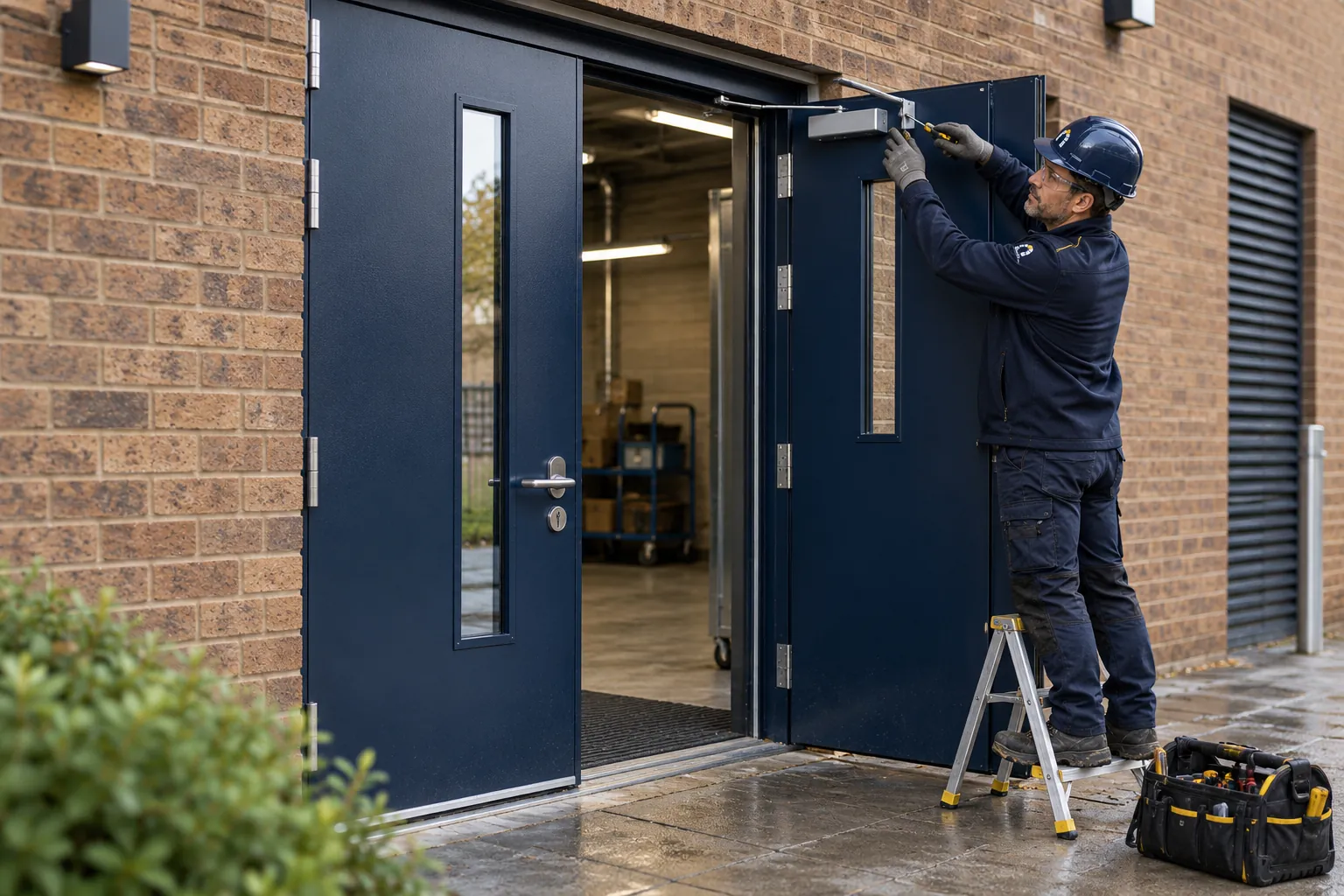
Security · LPS 1175 SR2 to SR5
Security doors
LPS 1175 security doors UK: steel doorsets rated SR2 to SR5 for forced entry, supplied with third-party test evidence and installed across the UK.
- ✓Third-party test evidence with every product
- ✓Written specification you can issue to tender
- ✓Supplied and installed across the UK
Get a free project quote
Rating, written specification and budget range within one working day.
Confidential. No cost, no obligation.
Third-party tested
Evidence with every quote
UK manufactured
Made to your sizes
One accountable team
Specify, supply, install
Confidential handling
Details never shared
Security doors are steel doorsets tested to LPS 1175 for forced entry, rated SR2 to SR5. ArxBridge supplies and installs the full range for commercial, public and industrial buildings across the UK. The right rating follows the attack time in your risk assessment. They are the core of the security range.
- SR2 to SR5LPS 1175 doorset range
- 3 to 10 minutesRated attack time, B3 to E10
- Single and double leafGlazed options available
- Third-party test evidenceSupplied with every doorset
What a security door is
A security door is a complete doorset: leaf, frame, locks, hinges and fixings tested together as one assembly. The rating does not belong to the leaf alone. It certifies that the whole assembly resisted the tools of its category for the rated minutes. ArxBridge supplies these doorsets with third-party test evidence for the exact configuration ordered.
Doorsets are built in steel, with single leaf, double leaf and glazed configurations. Glazed versions use attack-rated glass tested with the frame, so the vision panel does not become the weak point. Hardware is specified as part of the tested assembly: hinges, multi-point locks, closers and cylinders that match the rating. The LPS 1175 guide explains how the ratings are derived.
A rating is only as good as the assembly. The LPS 1175 test covers the leaf, frame, locks, hinges and fixings together. Swapping one part for an untested equivalent voids the rating.
Picking the rating for security doors
| Rating | Issue 8 code | Attack it resists | Where it is used |
|---|---|---|---|
| SR2 | B3 | 3 minutes with screwdrivers, pliers, hand saws | Plant rooms, back of house, lower-risk commercial |
| SR3 | C5 | 5 minutes with crowbars, drills, chisels | Offices, retail units, schools |
| SR4 | D10 | 10 minutes with sledgehammers, disc cutters, jigsaws | Cash handling, data centres, government |
| SR5 | E10 | 10 minutes against a wider tool set | Highest-risk sites |
Pick the rating from the threat, not from habit. A storeroom door and a cash office door on the same site can carry different ratings. Where the risk assessment is uncertain, ask for security consultancy before the schedule is fixed.
How a rated doorset is built
The leaf is a steel shell with internal reinforcement positioned where the test tools attack: around the lock, the hinges and the meeting stiles. The frame is anchored into the surrounding wall, because a strong leaf in a weak frame fails at the frame. Fixings are part of the tested assembly, not an installer choice.
Locking is multi-point on higher ratings, spreading the load across the leaf edge. Hinges are rated for the leaf weight and protected against removal. Cylinders and escutcheons resist drilling and pulling to the level of the doorset rating. On glazed doorsets, the glass is LPS 1270 rated and retained by a tested bead system, so the whole aperture keeps one rating.
Pairing security doors with other ratings
One doorset can carry more than one rating. Fire and forced entry is the most common pair: the assembly is tested to EN 1634-1 for fire and to LPS 1175 for attack (see fire and security doors). Ballistic ratings can be added where the threat includes firearms (see bullet resistant doors), and blast ratings where vehicle bombs are a concern (see blast resistant doors).
Thermal performance can be combined too: thermally broken steel doorsets hold a security rating with a lower U-value (see thermally broken doors). State every rating at quote stage. Each combination needs its own test evidence for the pair, not two certificates stapled together.
Where security doors are used
Government and defence estates specify SR3 and SR4 for offices, armouries and communications rooms (see government and defence). Data centres use rated doorsets on plant rooms, UPS rooms and the routes between security zones (see data centres). Retailers protect stockrooms and cash offices, and schools and colleges secure plant rooms, IT suites and server cupboards. The right rating follows the room, not the building.
Cost and lead time factors for security doors
The rating is the first driver: higher ratings need heavier construction and longer test programmes. Leaf size and configuration come next; double leaf and oversized doorsets take more material and more factory time. Glazing adds a second tested component, the glass and its retention system. Hardware choice matters too: access control integration, panic hardware and high-security cylinders each add supply and commissioning time.
Finish is a further factor. Powder coating in a standard colour is quicker than a special finish or a marine-grade system. Quantity changes the unit economics: a schedule of identical doorsets runs faster per door than ten different one-offs. Finally, site conditions affect installation time: restricted access, out-of-hours working and phased handovers all extend the programme. No prices are published here; every quote is built from the schedule.
How to specify security doors
- Set the rating. Name the SR level and the Issue 8 code, for example SR3 (C5), in the door schedule.
- Survey the openings. Record structural opening sizes, wall construction and floor levels for each door.
- Choose the configuration. Single or double leaf, glazed or solid, and the swing direction.
- List the hardware. Locks, cylinders, closers, panic hardware and any access control, all to suit the rating.
- Send the schedule. Drawings, quantities and the site location are enough for a firm quote.
Can a security door also be a fire door?
Yes, as one dual-rated assembly tested to both EN 1634-1 and LPS 1175. See fire and security doors. A standard security doorset on its own carries no fire rating.
What does the attack time number mean?
It is the minutes of attack the doorset must resist using the tools of its category. B3 means three minutes with tools such as screwdrivers, pliers and hand saws. D10 means ten minutes with sledgehammers, disc cutters and jigsaws. The number is attack time, not the total length of the test.
Does the rating cover the frame and locks?
Yes. LPS 1175 tests the complete doorset: leaf, frame, locks, hinges, glazing and fixings as one assembly. That is why hardware cannot be swapped for an untested equivalent after installation.
Single leaf or double leaf: does the rating change?
The rating applies to the configuration that was tested. A double leaf doorset is tested as a double leaf doorset, with its own meeting stile and locking arrangement. Order the configuration you need; do not assume a rating transfers between leaf layouts.
What do you need from me to quote?
Opening sizes, the SR rating, leaf configuration, hardware requirements, quantities and the site location. A door schedule or marked-up drawing is ideal, but a written list works too.
Get a free quote
Related
More in security doors, windows and entrance control
Ready to specify your project?
Free assessment, written specification and test evidence. Reply within one working day.