
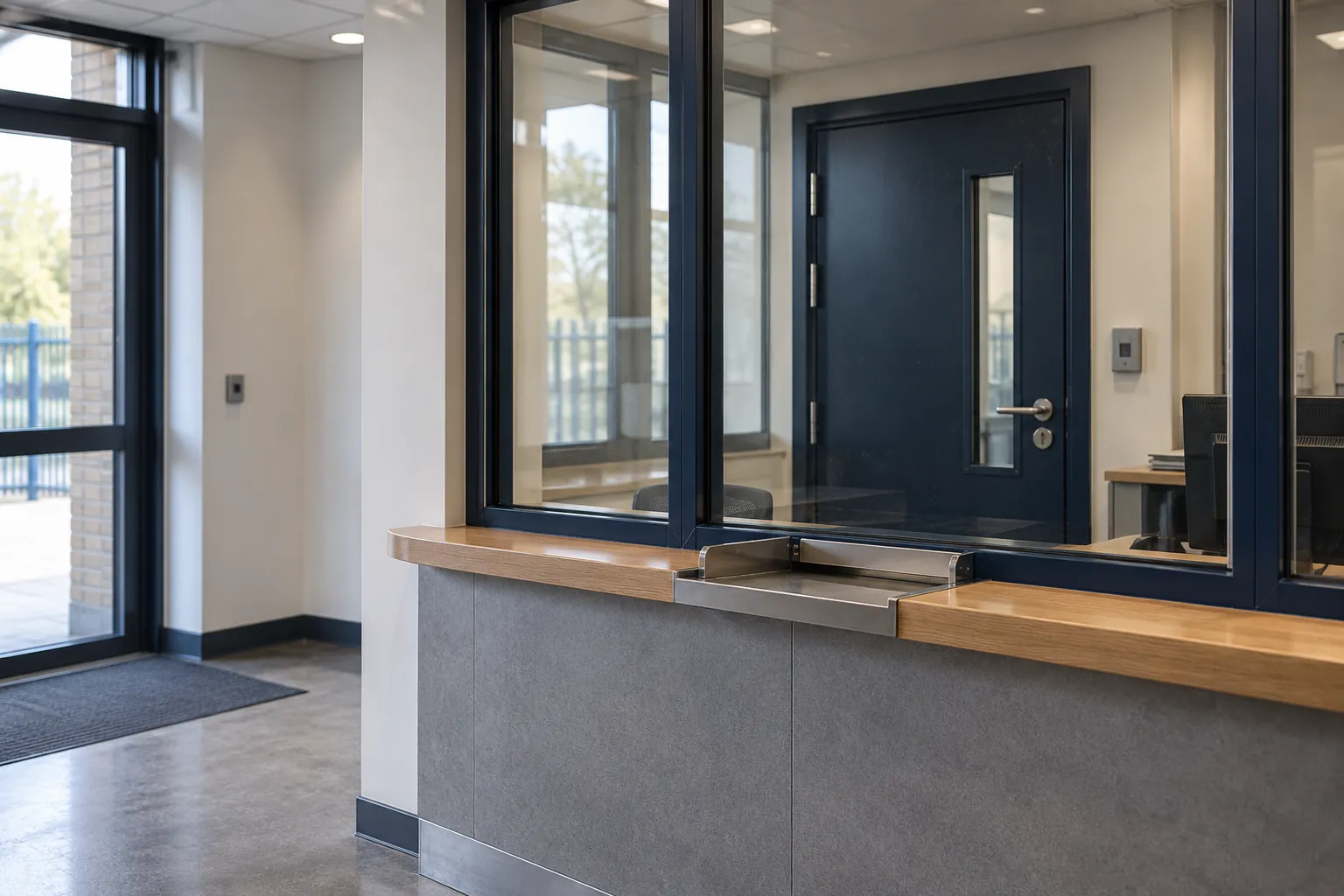
Ballistic · EN 1522 FB2 to FB7
Bullet resistant doors
FB4 to FB7 bullet resistant steel doorsets tested to EN 1522 as complete assemblies. Glazed, dual rated and made to size, installed across the UK.
- ✓Third-party test evidence with every product
- ✓Written specification you can issue to tender
- ✓Supplied and installed across the UK
Get a free project quote
Rating, written specification and budget range within one working day.
Confidential. No cost, no obligation.
Third-party tested
Evidence with every quote
UK manufactured
Made to your sizes
One accountable team
Specify, supply, install
Confidential handling
Details never shared
A bullet resistant door is only as good as its weakest part. We supply steel doorsets where the leaf, frame, glazing, hinges and locks are tested together to EN 1522, so the rating on the certificate is the rating you get on site.
- FB4 to FB7Ballistic classes to EN 1522
- Complete doorsetLeaf, frame, glazing and hardware tested as one
- Dual ratedOptions with LPS 1175, blast and fire ratings
- Made to sizeSingle, double and glazed designs
What is a bullet resistant door?
A bullet resistant door is a doorset built to stop a defined firearm and ammunition from passing through. In the UK and Europe the test standard is EN 1522, with EN 1523 setting out the test method. Three shots are fired at set points on the leaf, the frame and the joints between them. The doorset passes if no bullet or fragment gets through.
The result is a class from FB1 to FB7, followed by NS (no splinters) or S (splinters). NS means nothing left the protected face of the door. For rooms where people stand close to the door, NS is the safer choice.
Which ballistic class do you need?
The class follows the weapon you need to stop, not the type of building. Most commercial projects in the UK are specified at FB4. Government, police and defence projects usually start at FB6.
| Class | Stops | Typical use |
|---|---|---|
| FB4 | Handguns up to .44 Magnum | Banks, cash offices, reception and security lodges |
| FB5 | 5.56 mm rifle | Police buildings, courts, high-risk commercial sites |
| FB6 | 5.56 mm and 7.62 mm rifle | Embassies, government and critical infrastructure |
| FB7 | 7.62 mm armour-piercing rifle | Defence sites and the highest-risk rooms |
Not sure of the class? Your security consultant, insurer or client brief normally sets it. If none has, we assess the threat with you and recommend a class for each opening, free of charge.
How our bullet resistant doors are built
- Leaf: steel skins over a ballistic core, sized to the class. An FB4 leaf is far slimmer and lighter than an FB7 leaf.
- Frame: the frame and the gap between leaf and frame carry the same rating as the leaf. This is where untested doors fail.
- Glazing: vision panels and fully glazed designs use bullet resistant glass matched to the door class.
- Hardware: hinges, multi-point locks, closers and access control are part of the tested construction, including the cable routes.
- Finish: powder coated in any RAL colour, with cladding options so the door matches the rest of the building.
Combine ballistic with security, blast and fire ratings
High-risk openings rarely face one threat. The same doorset can also carry a forced entry rating to LPS 1175, a blast rating and a fire rating. Each rating needs its own test evidence for the same construction, and we supply that evidence with the quote.
- Security doors for forced entry
- Blast resistant doors for explosive threats
- Fire and security doors for escape routes and plant rooms
Where bullet resistant doors are used
- Government and defence: entrances, control rooms and armouries
- Data centres: security lodges and the route to the data hall
- Banking and finance: cash handling rooms and vaults
- High-value retail: back-of-house and strong rooms
- Private homes: safe rooms and main entrances, see residential ballistic security
What affects the cost and lead time?
Every doorset is made to order, so the price depends on the specification. The main factors are:
- the ballistic class (each step up adds weight and material)
- size, and single or double leaf
- the amount of glazing
- extra ratings for forced entry, blast or fire
- locking, automation and access control
- installation: heavier classes need lifting equipment and a checked structural opening
Send us the opening sizes and the class and we return a budget range within one working day.
How to specify a bullet resistant door
- Set the class. State the EN 1522 class and NS or S, for example “FB6 NS”.
- List the other ratings. Add forced entry, blast, fire, acoustic and thermal requirements for the same opening.
- Check the wall. The surrounding wall needs the same ballistic rating as the door, or the door is bypassed.
- Ask for the evidence. Request the test report for the complete doorset in the configuration you are buying.
Frequently asked questions
Is a bullet resistant door the same as a bulletproof door?
They mean the same product. “Bullet resistant” is the correct term because every door is rated against a specific weapon and ammunition. No door stops everything.
How heavy is a bullet resistant door?
It depends on the class and size. A handgun-rated FB4 leaf is far lighter than a rifle-rated FB6 or FB7 leaf. We confirm the weight with the quote so the structural opening and hinges can be checked.
Can a bullet resistant door have glass in it?
Yes. Vision panels and fully glazed doors are available. The glass must carry a matching rating and be tested in the door.
Do you install the doors?
Yes. Trained installers fit and commission the doorsets across the UK, and we offer planned maintenance afterwards.
Get a free quote
Related
More in ballistic protection
Ready to specify your project?
Free assessment, written specification and test evidence. Reply within one working day.