
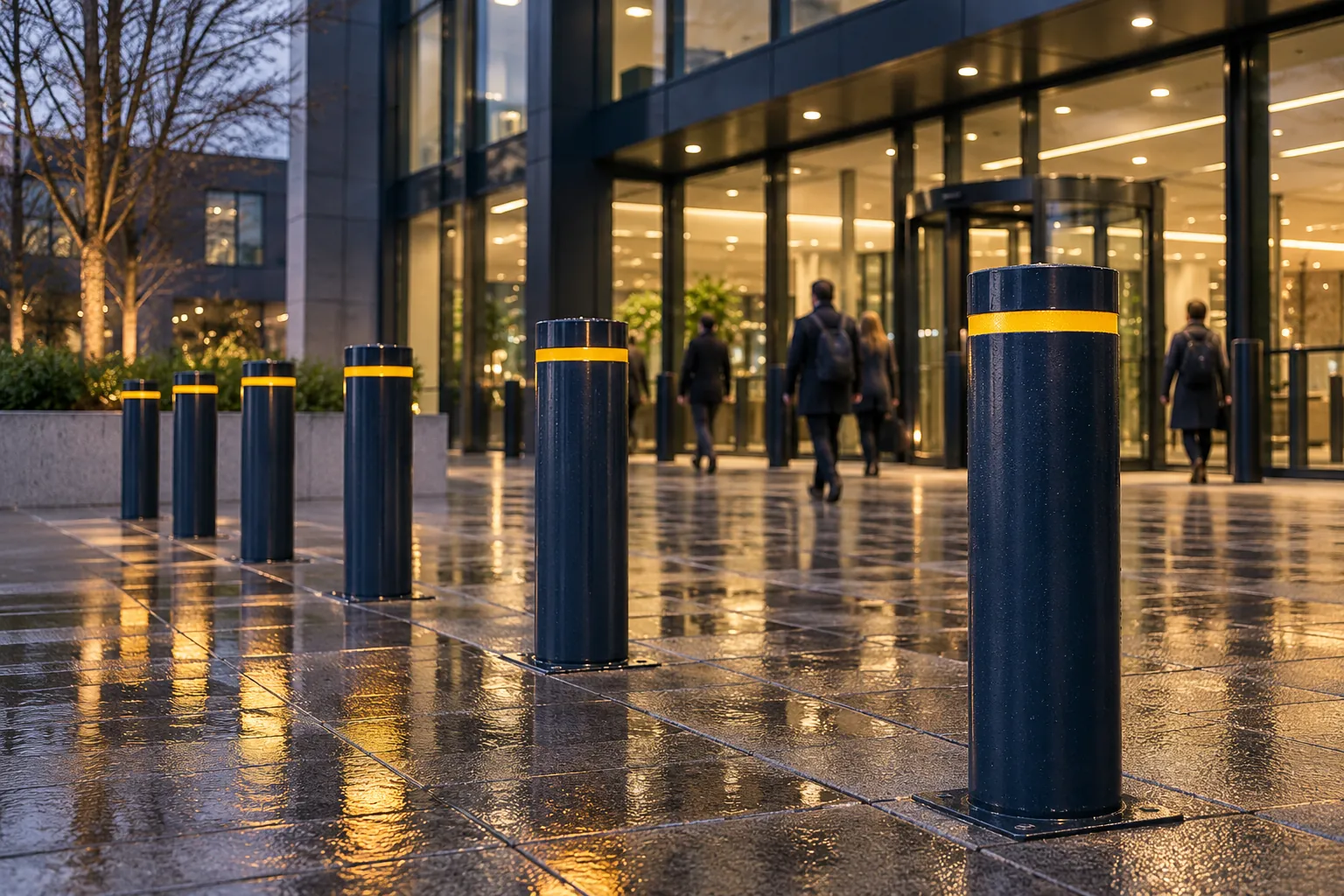
Perimeter and HVM · PAS 68 and IWA 14-1
Hostile vehicle mitigation
Hostile vehicle mitigation explained: PAS 68 and IWA 14-1 tested bollards, barriers, gates and street furniture for UK sites, supplied and installed.
- ✓Third-party test evidence with every product
- ✓Written specification you can issue to tender
- ✓Supplied and installed across the UK
Get a free project quote
Rating, written specification and budget range within one working day.
Confidential. No cost, no obligation.
Third-party tested
Evidence with every quote
UK manufactured
Made to your sizes
One accountable team
Specify, supply, install
Confidential handling
Details never shared
Hostile vehicle mitigation, or HVM, is the use of tested barriers to stop a vehicle attack before it reaches a building. It covers bollards, barriers, gates and street furniture, each tested against a defined vehicle at a defined speed. The range lets specifiers set the stand-off distance and the rating each line of defence must meet.
- PAS 68 and IWA 14-1Impact test standards for HVM barriers
- 1,500 to 30,000 kgTest vehicle masses in the standards
- Test speeds 48 to 80 km/hStandard impact velocities
- Standoff decides safetyDistance between barrier and facade
What is hostile vehicle mitigation
HVM is the set of physical measures that stop or divert a vehicle being used as a weapon. It sits at the boundary of a site and forms the delay layer of a layered security plan: deter, detect, delay. The barrier buys time and distance while access control manages legitimate vehicles and the building facade resists what gets through.
The range covers security bollards for footways and forecourts, security gates and sliding vehicle gates for entrances, and HVM street furniture for public spaces that must stay welcoming. Our perimeter and HVM hub introduces each product in the range.
Which rating do you need for hostile vehicle mitigation
Start from the threat vehicle and the speed it could reach on the approach to your site. The table below shows how specifiers commonly match vehicle and speed to a test. Read the full rating designation as well: the penetration distance and the impact angle complete the picture.
| Threat vehicle | Test speed | Where specifiers use it |
|---|---|---|
| 1,500 kg car | 48 km/h | Urban footways, forecourts and retail frontages |
| 2,500 kg 4×4 | 64 km/h | City centres and venue approaches |
| 3,500 kg van | 64 km/h | Transport interchanges and business parks |
| 7,200 or 7,500 kg truck | 48 to 80 km/h | Government sites and critical infrastructure |
| 30,000 kg truck | 80 km/h | Highest threat sites with long straight approaches |
The method behind these figures is explained in our vehicle impact ratings guide, which covers PAS 68, IWA 14-1 and ISO 22343-1:2023.
How HVM barriers work
A barrier stops a vehicle by absorbing its kinetic energy and passing the load into its foundations. That is why the rating covers the installed system, not the product on its own. A bollard that passed its test in one foundation detail does not carry the rating in a different one.
Standoff is the distance between the barrier line and the facade. Every metre of standoff reduces the effect of a vehicle-borne threat on the building. Set the barrier line as far from the facade as the site allows, then choose products that fit the line.
Design the line, then the product. Walk the boundary, mark every vehicle approach, and fix the barrier line before choosing products. Gaps at driveways and service yards undo the protection of the rest of the line.
Combining HVM with other ratings
Barriers handle the vehicle; the building still needs its own layers. At entrances, pair the barrier line with rated gates and pedestrian control such as security portals. Behind the standoff, harden the facade with blast rated curtain walling for glazed areas, blast resistant doors at service entrances and security doors rated to LPS 1175 against forced entry.
Where HVM is used
Government and defence estates use HVM at perimeters, car parks and delivery yards. Transport hubs protect forecourts and drop-off zones where vehicles mix with crowds. Public spaces such as squares and event venues need protection that does not spoil the setting. Data centres guard compounds and generator yards where an outage would be costly.
What sets the cost and lead time for hostile vehicle mitigation
Several factors set the budget and programme. The length of the protected line and the number of vehicle entrances drive quantities. Foundation depth and ground conditions decide the civil work, and buried services may force a shallow mount detail. Operable elements such as gates and removable bollards add mechanical and electrical scope. Finish, for example powder coating to a site palette, and work in conservation areas each add coordination time. No prices are given here because every site differs.
How to specify HVM
- Define the threat. Name the vehicle mass and the speed it could reach on each approach.
- Set the standoff. Fix the distance from the barrier line to the facade.
- Choose barrier types. Match bollards, gates or street furniture to each zone.
- Confirm the foundation. Build to the tested foundation detail, without changes.
- Coordinate access. Keep routes for deliveries, refuse collection and emergency vehicles.
- Ask for test evidence. Request third-party test evidence naming the standard and the rating.
Hostile vehicle mitigation FAQs
How do PAS 68 and IWA 14-1 differ?
PAS 68 is the UK test standard for vehicle security barriers; IWA 14-1 is its international equivalent. ISO 22343-1:2023 is the current international standard and supersedes both. The test method is similar while the rating designation format differs, and UK specifiers usually ask for PAS 68.
What is penetration distance?
It is how far the test vehicle travelled past the barrier line after impact. A rating with a short penetration distance lets you work with less standoff to the facade. Always read it alongside the vehicle and speed figures.
Can HVM be added to an existing street?
Often, yes. Shallow mount security bollards suit streets where buried services rule out deep foundations. A survey of services and levels comes before any product choice.
Does Martyn’s Law require HVM?
The Terrorism (Protection of Premises) Act 2025 does not mandate specific products. Enhanced tier premises must consider physical measures as part of their plans. Our Martyn’s Law guide explains the tiers and the timetable.
Who looks after HVM barriers?
The site estates team, with support from the installer. Fixed barriers need little attention; gates and removable bollards need periodic checks of their moving parts. Our maintenance service covers operable HVM elements.
Get a free quote
Related
More in perimeter security and hvm
Ready to specify your project?
Free assessment, written specification and test evidence. Reply within one working day.