
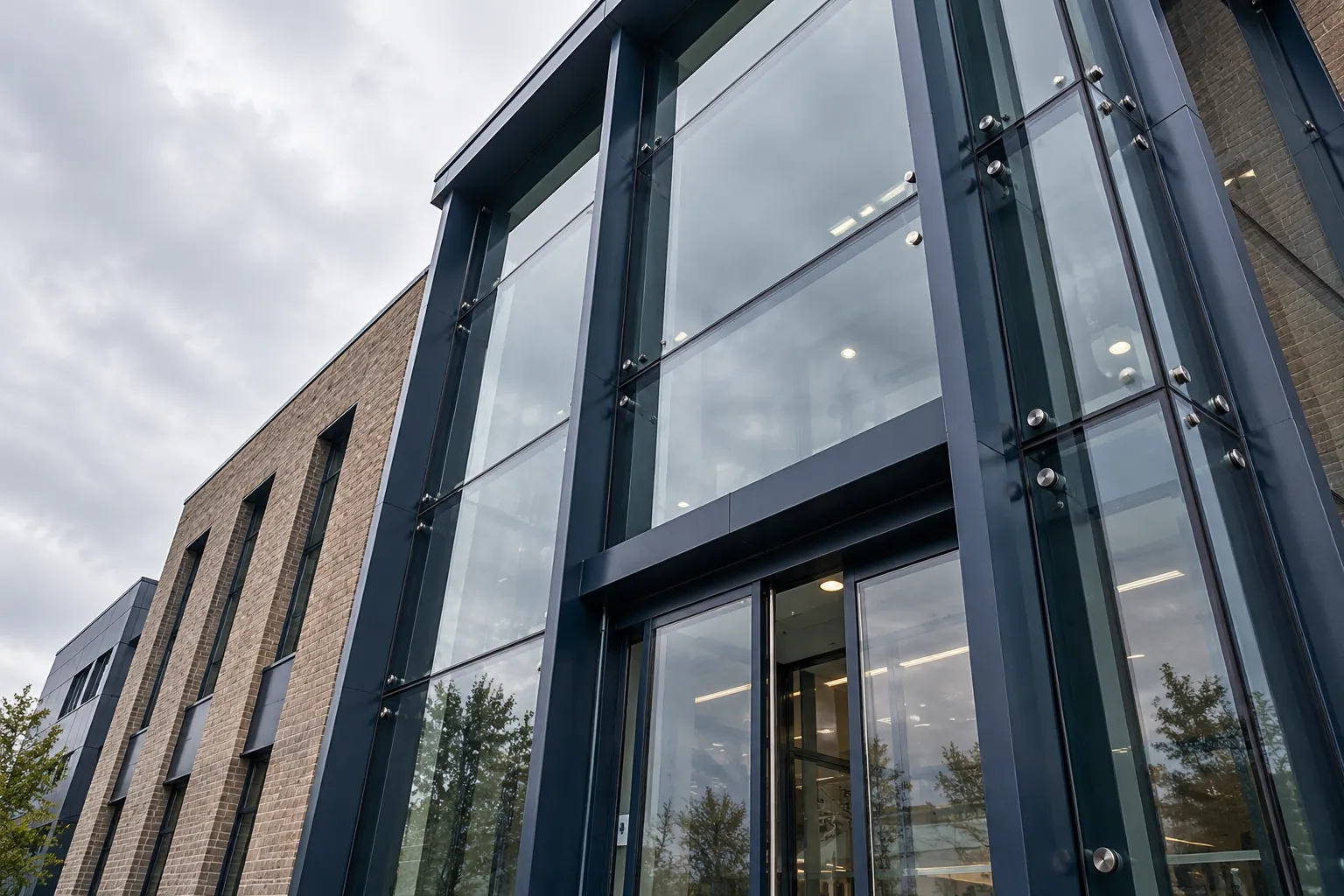
Blast · ISO 16933 EXV45 to EXV10
Blast resistant glass
Blast resistant laminated glass matched to its tested frame, rated to ISO 16933 with hazard ratings A to F. Supply and installation across the UK.
- ✓Third-party test evidence with every product
- ✓Written specification you can issue to tender
- ✓Supplied and installed across the UK
Get a free project quote
Rating, written specification and budget range within one working day.
Confidential. No cost, no obligation.
Third-party tested
Evidence with every quote
UK manufactured
Made to your sizes
One accountable team
Specify, supply, install
Confidential handling
Details never shared
Blast resistant glass is laminated glazing engineered to hold together under blast loading. ArxBridge supplies it as part of tested window and facade systems across the UK, because the glass only performs when it is matched to its frame.
- Laminated constructionMultiple panes bonded with interlayers
- A to FHazard ratings under ISO 16933
- Matched to frameTested as a complete system
- Made to orderCut and bonded for each project
About blast resistant glass
Blast resistant glass is not a single product but a family of laminated make-ups: glass panes bonded with polymer interlayers that stretch instead of shattering. Under blast load the glass cracks, the interlayer holds the fragments in a sheet, and the sheet stays captured in the frame. The thicker the laminate and the tougher the interlayer, the higher the performance. The Blast range overview sets out the systems this glass goes into.
The critical point, and the one most specifications get wrong, is that the glass has no rating on its own. ISO 16933 tests the assembly: glass, frame, gaskets, fixings and the way the frame is anchored. The same laminate in a different frame is an untested combination. Always specify glass and frame from one tested system; blast resistant windows shows what those systems look like.
ArxBridge supplies the glass within those systems, with third-party test evidence naming the exact make-up: pane thicknesses, interlayer type and count, and the frame it was tested in.
Choosing the right rating for blast resistant glass
| What to specify | What it controls | Guidance |
|---|---|---|
| EXV class | The structural blast load | From the threat assessment |
| Hazard rating A to C | Lower fragment hazard | For rooms with seated occupants |
| Hazard rating D to F | Higher fragment hazard | Accept only with a documented reason |
| Laminate make-up | Glass and interlayer build | Must match the test evidence exactly |
The specifier names the EXV class and the target hazard rating, then requires test evidence for the exact laminate in the exact frame. The blast ratings guide sets out the full class and hazard scale.
Glass has no solo rating. A laminate quoted without its tested frame is a guess, not a specification. Insist on the system test report.
Inside blast resistant glass
The laminate starts as flat glass panes bonded under heat and pressure with interlayers. Common interlayers are PVB and ionoplast; ionoplast is stiffer and is used where the performance demand is higher. Multiple interlayers can be stacked between panes for severe ratings.
The glass edge is the weak point. In a blast system the edge is captured deep in the frame rebate and bonded with structural sealant, so the deflecting membrane cannot pull out. Edge cover, bite depth and sealant type are all fixed by the test; the design team details them from the test report, not from catalogue defaults.
Sealed units add a second pane for thermal insulation, and coatings add solar control or low emissivity performance. These sit outside the blast laminate and must not change the tested build-up. Any substitution, even of a coating, needs checking against the evidence.
Pairing blast resistant glass with other ratings
Blast laminates combine naturally with other performances in the same pane. Attack resistance to LPS 1270 uses similar laminated build-ups; LPS 1270 security glazing explains the three-digit rating for hand hole, arm hole and body passage. Ballistic ratings to EN 1063 use thicker laminates with polycarbonate layers; bullet resistant glass covers BR1 to BR7.
The skill is in the stacking order: the blast interlayer, the ballistic layers and the thermal coatings must sit in the positions the test evidence names. A laminate that is tested for blast alone cannot be assumed to stop a bullet, and a ballistic laminate cannot be assumed to control blast fragments.
Where the frame must stay and the glass must improve, blast protection window film is the retrofit route rather than replacement glazing.
Typical uses for blast resistant glass
Anywhere a tested window or facade system goes: government and defence offices, transport hubs, data centres and public spaces with glazed frontages. The glass is always discussed as part of the system, never alone.
High-value retail uses blast laminates in flagship frontages where the glazing line is the security line. Banking and finance branches use them at ground floor glazing behind which staff work.
For full glazed elevations the system becomes blast rated curtain walling; for individual openings it stays as blast resistant windows.
What affects the cost and lead time of blast resistant glass
Laminate thickness is the main driver: more glass and more interlayer means more material and longer bonding time. Large panes add handling and transport complexity; oversized laminates may need specialist delivery and lifting gear on site.
The frame system matters as much as the glass. Deeper, heavier frames for severe ratings need more metal and longer fabrication. Coatings, acoustic upgrades and decorative interlayers each add a process step.
Blast laminates are made to order and cannot be cut on site, so the survey must be exact and the programme must allow the full manufacturing slot. Late changes to sizes mean remaking the glass.
Specifying blast resistant glass
- Name the system, not the glass. Specify the tested window or facade system, with the laminate make-up as part of it.
- Set class and hazard. State the EXV class and the target hazard rating from the threat assessment and room use.
- Fix the build-up. Record pane thicknesses, interlayer types and coatings exactly as tested.
- Demand the evidence. Ask for the ISO 16933 test report naming the laminate, the frame and the fixing method.
- Protect the programme. Freeze sizes early with the installation team; blast glass cannot be trimmed on site.
What is the interlayer, and why does it matter?
The polymer sheet bonded between the glass panes. Under blast load it stretches and holds the broken glass together. Stiffer interlayers give higher performance; the type and number of interlayers are fixed by the test evidence.
Can blast glass be double glazed?
Yes. The blast laminate forms one pane of a sealed unit, with a second pane and a cavity for thermal performance. The sealed unit build-up must match the tested configuration.
Does blast glass stop bullets?
Not automatically. Blast and ballistic are different tests with different laminate designs. Where both threats apply, specify a laminate tested to both ISO 16933 and EN 1063, and check both reports.
How thick is blast resistant glass?
It varies with the rating: higher EXV classes and better hazard ratings need thicker laminates. The test report for the system you specify states the exact make-up; there is no standard thickness.
Can existing glass be upgraded to blast glass?
The glass can only be upgraded by replacing it within a tested frame system. Where the frame must stay, blast protection window film fitted to the existing panes is the practical alternative.
Get a free quote
Ready to specify your project?
Free assessment, written specification and test evidence. Reply within one working day.